
2026 Excavator Tracks Market Trends for Urban Construction Projects
Why Excavator Tracks Matter in Urban Construction Procurement
As urban infrastructure projects accelerate globally, procurement strategies for heavy machinery components must adapt. Sourcing undercarriage parts is no longer a routine maintenance afterthought; it has evolved into a critical driver of project profitability and operational efficiency.
Among these vital components, high-quality Excavator Tracks are essential for navigating the complex physical and regulatory constraints of modern city jobsites. Procurement teams face increasing pressure to balance upfront capital expenditures with the long-term durability required by demanding municipal contracts.
By strategically evaluating and sourcing these tracks, buyers can mitigate the financial risks of unexpected machinery downtime while protecting the sensitive paved surfaces common in metropolitan environments.
Urban jobsite constraints driving demand
Urban environments present unique logistical challenges, including strict noise ordinances, vibration limits, and the necessity of preserving existing asphalt and concrete infrastructure. These constraints heavily skew procurement demand toward advanced continuous rubber tracks that distribute machine weight evenly, minimizing destructive ground pressure and disruptive operational noise.
Top buyer priorities for distributors and procurement teams
For B2B distributors and fleet procurement managers, total cost of ownership (TCO) remains the paramount metric. Buyers prioritize supply chain reliability, consistent tread wear performance, and immediate availability of fast-moving SKUs to ensure urban contractors avoid crippling delays waiting for replacement undercarriage parts.
Commercial risks and margin opportunities
Procuring substandard tracks introduces severe commercial risks, including premature cable snapping and costly project delays. Conversely, distributors sourcing premium, jointless rubber tracks can capture higher margin opportunities by positioning their inventory as a direct solution to the downtime risks that challenge urban construction project managers.
Excavator Track Types and Specifications to Compare
When evaluating undercarriage components for wholesale catalogs or fleet operations, technical differentiation is critical. Buyers must look beyond baseline pricing to understand the engineering specifications that dictate field performance. A track’s structural integrity directly correlates with its operational lifespan and suitability for specific environments.
Navigating the technical landscape requires a firm grasp of how core materials interact with machine weight and terrain. For urban applications, the distinction between track types and internal construction can mean the difference between 500 and 1,500 hours of service life.
To make informed purchasing decisions, procurement teams rely on rigorous comparisons of Rubber Excavator Tracks across multiple technical dimensions, ensuring the selected product aligns perfectly with the intended machine class and application.
Rubber vs steel tracks for urban projects
While steel tracks offer unmatched durability for aggressive mining or demolition, rubber tracks are strictly favored for urban projects. Rubber eliminates the need for protective street pads, prevents damage to municipal roads, and significantly dampens vibrations that disturb densely populated neighborhoods.
Core specifications: pitch, width, link count, tread, cable, compound
Technical evaluations hinge on six core metrics: track width, pitch (distance between links), total link count, tread pattern (e.g., block vs. C-lug), internal cable architecture, and rubber compound formulation. Jointless, continuous steel cords embedded within a high-tensile natural and synthetic rubber blend are non-negotiable standards for premium urban SKUs.
Key comparison points: machine class, application, service life, price, replacement cycle
To streamline procurement, buyers utilize standardized matrices to compare tracks based on operational metrics.
| Specification | Standard Urban Rubber Track | Premium Urban Rubber Track |
|---|---|---|
| Compound | Standard Natural Rubber | High-Tensile Synthetic Blend |
| Cable Type | Overlapping Cords | Continuous/Jointless Cords |
| Expected Life | 800 – 1,000 Hours | 1,500 – 2,000 Hours |
| Ground Pressure | Moderate | Low |
2026 Market Trends in Excavator Tracks
Looking toward 2026, significant shifts in the undercarriage market are driven by stricter municipal environmental regulations and the electrification of compact construction equipment. As electric mini-excavators become standard in city centers, their supporting components must evolve to maximize battery life and minimize noise.
The global push for sustainable urban development forces manufacturers to rethink traditional production methods. There is a distinct move away from highly toxic curing agents toward advanced, eco-friendly rubber blends that maintain tensile strength and abrasion resistance.
By aligning procurement strategies with these emerging trends, distributors ensure their inventory of Excavator Rubber Tracks remains highly competitive and fully compliant with future jobsite mandates.
Growth in low-ground-pressure and low-vibration tracks
Chart: 5-Year Projected Demand Shift for Urban Construction Tracks
- 2022: Standard Tread (60%), Low-Vibration (40%)
- 2024: Standard Tread (45%), Low-Vibration (55%)
- 2026: Standard Tread (25%), Low-Vibration (75%)
We anticipate exponential growth in low-vibration tracks designed with offset tread patterns, which significantly reduce operator jolting and lower the machine’s overall decibel output.
OEM compatibility and aftermarket standardization
There is a strong trend toward aftermarket standardization, where top-tier suppliers engineer tracks that meet or exceed OEM specifications across multiple brands (e.g., Kubota, Bobcat, Caterpillar). This cross-compatibility allows procurement teams to consolidate SKUs and reduce inventory bloat.
Sustainability and longer-life compounds in sourcing
Environmental compliance is reshaping supplier selection. Buyers increasingly prioritize manufacturers utilizing sustainable carbon black alternatives and longer-life anti-chunking compounds, which extend the replacement cycle and reduce industrial rubber waste in landfills.
How to Evaluate Suppliers and Sourcing Models
Establishing a resilient supply chain requires looking far beyond the initial quoted price per unit. Procurement teams must rigorously audit potential manufacturing partners to ensure they possess the necessary production capacity, technological infrastructure, and financial stability to support long-term volume requirements.
The evaluation process should be highly systematic, focusing on the supplier’s internal quality management systems and historical export performance. A supplier’s ability to consistently deliver heavy, bulky goods across international borders without logistical hiccups is just as vital as the quality of the rubber they pour.
To maintain a competitive edge, sourcing models are structured around scalable partnerships. This involves negotiating favorable terms for DiggerTracks that allow for branding flexibility and rapid response to localized market demands.
Supplier qualification: capacity, QC, testing, export experience
Strict supplier qualification protocols are essential, requiring ISO 9001 certification, in-house dynamic tensile testing capabilities, and verified export experience to North American or European markets. A robust factory audit must demonstrate an automated vulcanization process and strict batch-tracking protocols.
MOQ, private label, tooling, and model coverage
For wholesale operations, buyers negotiate Minimum Order Quantities (MOQs) that align with container limits, typically seeking suppliers offering mixed-SKU containers. It is also crucial to evaluate the supplier’s willingness to invest in custom tooling for proprietary tread patterns and their capability to execute seamless private labeling for distributor networks.
RFQ, sample approval, pilot orders, and annual contracts
The sourcing lifecycle follows a strict phased approach: detailed Request for Quotation (RFQ), destructive testing of physical samples, and low-volume pilot orders deployed in real-world urban conditions. Only after successful pilot validation should buyers lock in annual volume contracts to secure favorable pricing tiers.
Compliance, Quality Control, and Warranty Requirements
In the heavy machinery sector, regulatory compliance and stringent quality control are not optional; they are the bedrock of brand reputation and legal liability management. Distributors cannot afford to introduce undercarriage components into the supply chain that fail to meet recognized international safety and chemical standards.
Quality control must be verified at the origin before a single container is loaded. Deploying third-party inspectors to conduct rigorous pre-shipment inspections ensures that physical dimensions, core strength, and material bonding meet exact engineering drawings.
Furthermore, a robust warranty framework is essential for protecting downstream B2B customers. Manufacturing partners must stand behind their products with clear, enforceable warranty terms covering premature structural failures.
Required compliance documents for regulated markets
Full documentation is required for every shipment, including CE declarations for the European market and REACH compliance certificates verifying that rubber compounds are free from restricted hazardous chemicals. Without these, shipments risk severe customs delays.
Inspection checkpoints for strength, dimensions, and bonding
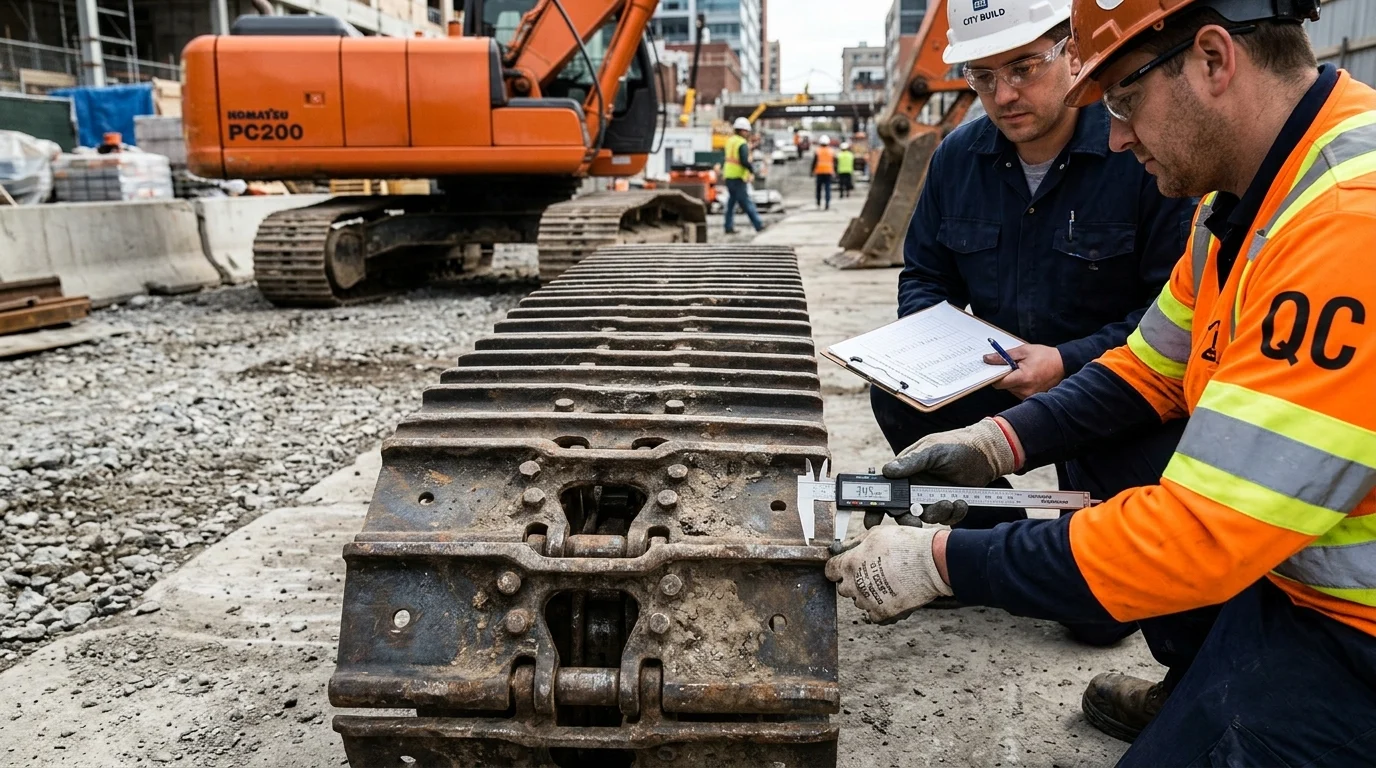
Pre-shipment QC checklists must be exhaustive. Inspectors verify track pitch dimensions to the millimeter, conduct ultrasonic testing to ensure the integrity of continuous steel cords, and perform shore hardness tests on rubber lugs to confirm optimal vulcanization and bonding strength.
Warranty terms, claims process, and failure analysis
Buyers standardly negotiate a minimum 1,000-hour or 12-month prorated warranty against manufacturing defects such as cable snapping or iron core delamination. The claims process must be streamlined, requiring only photographic evidence of the serial number and failure point, supported by the factory’s prompt root-cause failure analysis.
Packaging, Shipping, and Inventory Planning
The logistics of moving heavy rubber undercarriage parts dictate a significant portion of landed costs. Packaging and shipping strategies must be meticulously planned to maximize container utilization while minimizing handling damage during transit and warehousing.
Because these components are incredibly dense and heavy, they frequently “weigh out” a shipping container long before they “cube out” (fill the physical volume). This requires logistics teams to master the geometry and weight distribution of international freight to avoid costly dead freight charges.
Effective inventory planning for Digger Rubber Tracks also requires balancing the long lead times of ocean freight with the immediate, unpredictable demands of urban construction contractors who cannot afford machinery downtime.
Packaging formats that reduce damage and handling cost
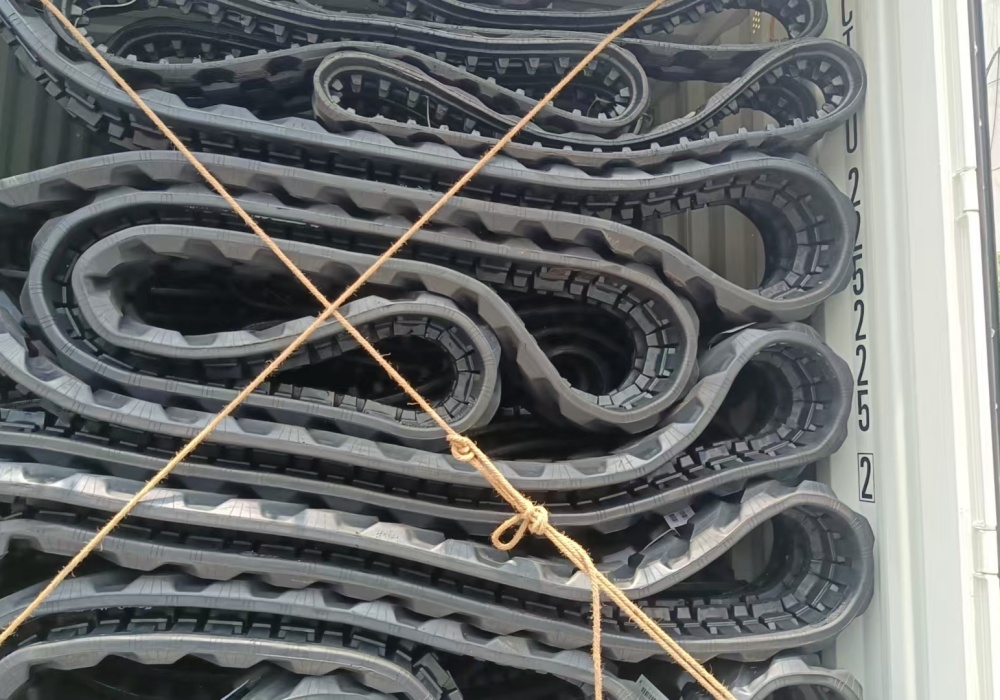
Suppliers should use heavy-duty, fumigated wooden or steel pallets, with tracks tightly coiled and secured by high-tensile steel banding. Shrink-wrapping is required to prevent UV degradation and moisture accumulation during extended ocean transits and open-air yard storage.
Container efficiency, lead times, Incoterms, and port risk
Due to gross weight limitations, shipments are typically optimized around 20-foot TEU containers rather than 40-footers. Sourcing under FOB (Free On Board) Incoterms helps maintain control over freight forwarders, factoring in standard 45-to-60-day lead times while constantly monitoring global port congestion risks.
Inventory metrics for urban construction SKUs
Utilizing a hub-and-spoke inventory model allows distributors to maintain high safety stock levels for fast-moving mini-excavator sizes (e.g., 300mm and 400mm widths) at regional distribution centers. Slower-moving, specialized low-ground-pressure sizes are managed via Just-In-Time (JIT) forecasting tied directly to upcoming municipal project bids.
Channel Strategy, Pricing, and Buyer Takeaways
Successfully commercializing heavy machinery undercarriage parts requires a nuanced understanding of diverse B2B buyer segments. Channel positioning must be tailored to address the distinct operational pressures faced by equipment rental houses, independent dealers, and municipal fleet managers.
Pricing strategy in this sector is highly sensitive to raw material fluctuations, particularly natural rubber and steel indices. Dynamic pricing models protect margins while offering compelling value propositions to high-volume B2B partners.
Ultimately, the goal is to empower procurement teams with the data and strategic insights needed to make confident purchasing decisions that enhance operational efficiency and bottom-line profitability.
Channel positioning across OEM, aftermarket, rental, and municipal buyers
Sales channels must be segmented aggressively. For national rental fleets, tracks are positioned as high-durability solutions that lower maintenance overhead. For independent aftermarket dealers, the emphasis is on competitive pricing and cross-brand compatibility, while municipal buyers receive messaging focused on low-vibration, infrastructure-friendly performance.
Pricing framework: landed cost, margin, rebates, and volume tiers
A strong pricing framework is built strictly on total landed cost, factoring in raw material indexes, ocean freight, and import tariffs. B2B pricing is structured with transparent volume tiers, offering quarterly rebate incentives to distributors who consistently hit container-load purchasing targets.
Key takeaways and FAQs for procurement teams
For procurement teams, the ultimate takeaway is that prioritizing continuous cable technology and premium rubber compounds yields the lowest TCO for urban projects. When evaluating an RFQ, always demand transparency on compound formulation, insist on stringent pre-shipment QC, and ensure the supplier’s logistics capabilities align with inventory turnover targets.
Key Takeaways
- Wholesale sourcing and supply-chain implications for Excavator Tracks
- Specifications, compliance, and commercial terms buyers should validate
- Actionable recommendations for distributors and procurement teams