
Introduction
As construction and earthmoving fleets shift between asphalt, concrete, mud, and rock, bolt-on rubber track pads have become a practical way to protect surfaces without sacrificing machine mobility. Recent product upgrades from global suppliers reflect rising demand for pads that improve traction, reduce vibration and noise, and hold up better under mixed operating conditions. This article explains why the market is expanding, what design improvements are shaping newer pad options, and how these changes can help contractors balance compliance, undercarriage protection, and productivity across diverse terrains.
Why Suppliers Are Expanding Bolt-On Rubber Track Pads
Global manufacturers are scaling the production of bolt-on rubber track pads to address the growing demand for versatile, multi-surface heavy machinery operations. By allowing steel-tracked excavators, compact track loaders, and tracked dumpers to operate on finished surfaces without inflicting damage, these pads bridge the gap between aggressive off-road traction and urban infrastructure protection. The economic advantage is substantial: fleet operators avoid the labor-intensive process of swapping entire track groups or deploying secondary transport vehicles when moving equipment across varying substrates.
Market drivers behind product expansion
The primary catalyst for this product expansion is the tightening of municipal regulations regarding infrastructure preservation and noise pollution. Urban contractors face strict penalties for pavement scarring, driving the rapid adoption of rubber mitigation strategies. Furthermore, modern bolt-on rubber track pads reduce operational noise emissions by up to 15 decibels compared to bare steel tracks, a critical compliance metric for residential and nocturnal construction zones.
Equipment operators also benefit from a significant reduction in high-frequency vibrations. Lowering continuous vibration exposure levels not only complies with stringent occupational safety standards but also extends the operational lifespan of the machinery’s undercarriage components, such as rollers and idlers, by dampening kinetic shock.
How upgraded pads meet equipment needs
Upgraded pad designs incorporate advanced vulcanization techniques and proprietary rubber compounds to withstand the dynamic lateral loads of 5-ton to 25-ton equipment classes. Unlike older iterations that suffered from premature chunking or tearing, contemporary bolt-on pads utilize a specialized natural and synthetic rubber blend bonded seamlessly to a heavy-duty steel core. This structural reinforcement prevents the pad from flexing under shear stress, ensuring the mounting hardware remains secure.
To accommodate diverse equipment needs, suppliers now offer distinct configurations, including direct-to-chain and direct-to-shoe mountings. Manufacturers are standardizing pitch measurements and engineering high-tensile threaded studs that require precise torque specifications—typically between 85 and 110 Nm—to guarantee seamless retrofitting and structural integrity across major OEM undercarriage systems.
How to Evaluate Bolt-On Rubber Track Pads
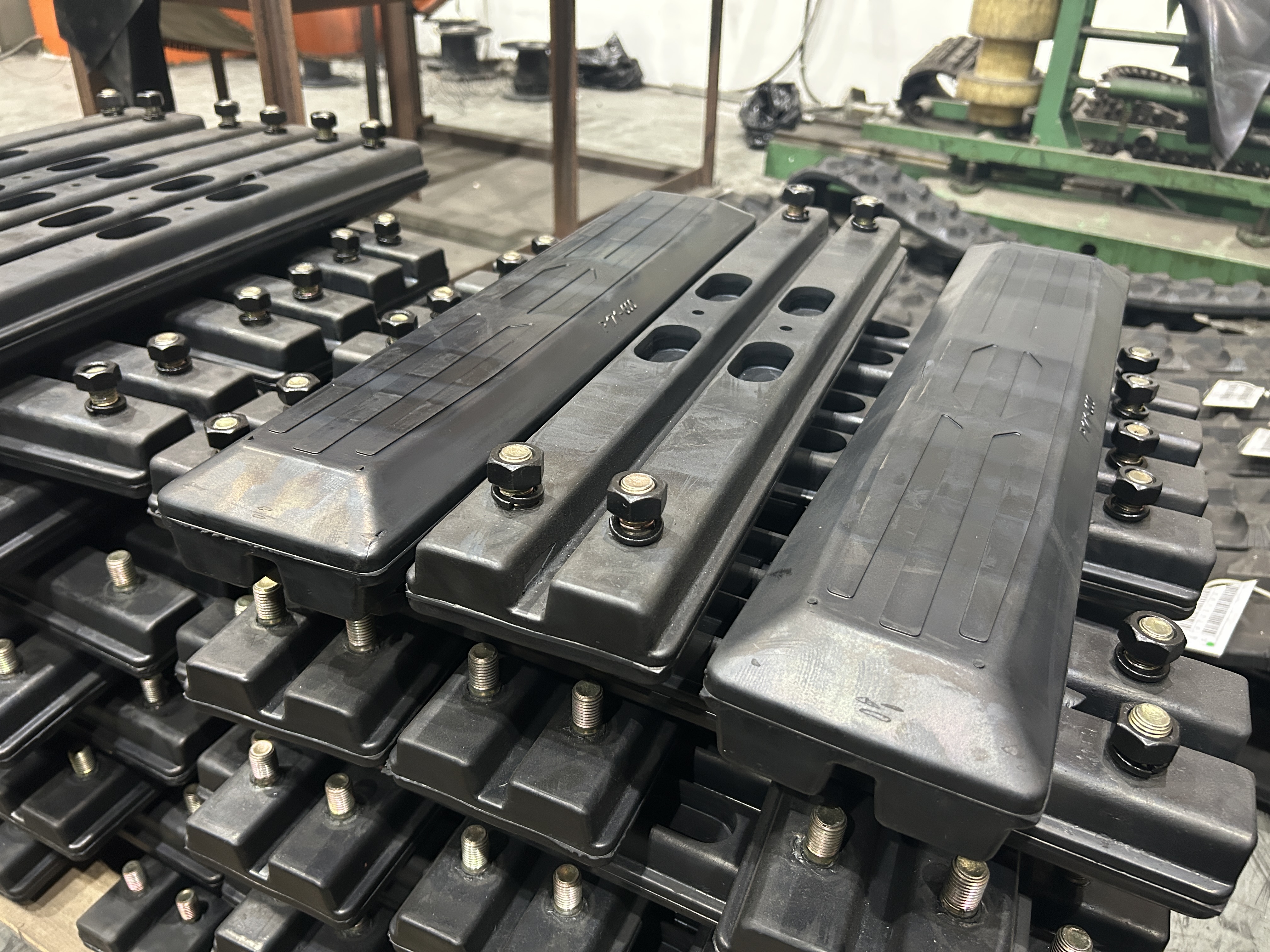
Procurement engineers must implement rigorous technical and commercial evaluations when specifying bolt-on rubber track pads. The physical properties of the elastomer blend directly dictate the component’s operational lifecycle and durability, while supply chain parameters heavily influence the total cost of ownership and fleet uptime.
Technical factors that affect performance
Evaluating pad performance requires analyzing the elastomer’s physical specifications and chemical composition. High-grade pads typically exhibit a durometer hardness rating between 75 and 80 Shore A, offering an optimal balance between cut resistance and flexibility. Tensile strength and tear resistance are equally critical, as the pads must endure high-torque pivot turns on highly abrasive substrates like milled asphalt, crushed concrete, and demolition debris.
Carbon black ratios and anti-oxidation additives play a vital role in UV resistance and thermal stability, preventing the rubber from degrading during high-friction transit. The following table outlines standard performance benchmarks across different pad classifications:
| Pad Classification | Hardness (Shore A) | Tensile Strength (MPa) | Expected Lifespan (Hours) | Ideal Application |
|---|---|---|---|---|
| Standard Duty | 70 – 75 | 14 – 16 | 800 – 1,200 | Dirt, light gravel, turf |
| Heavy Duty (HD) | 75 – 80 | 18 – 22 | 1,500 – 2,000 | Asphalt, concrete, debris |
| Non-Marking | 72 – 78 | 15 – 18 | 1,000 – 1,500 | Warehouse floors, pavers |
Commercial criteria buyers should compare
Beyond technical specifications, commercial evaluation centers on warranty terms, minimum order quantities (MOQs), and replacement availability. Tier-one suppliers typically offer a pro-rated warranty of 12 to 18 months or 1,000 operational hours against manufacturer defects, such as premature delamination or steel core separation.
Buyers must also assess MOQs, which generally range from 100 to 200 units for standard dimensions, but can scale significantly for custom polymer formulations. Factoring in lead times is essential to prevent machine downtime during peak construction cycles. While domestic inventories may offer immediate dispatch, custom batches sourced internationally often require 4 to 8 weeks for oceanic freight and customs clearance, necessitating accurate demand forecasting.
How Buyers Should Source and Select Suppliers
Establishing a reliable supply chain for undercarriage wear parts requires vetting manufacturing facilities for quality assurance and logistical consistency. Buyers must look beyond initial unit pricing to assess the systemic reliability and scalability of the supplier’s operations.
Steps to verify supplier capability
Verification begins with auditing the manufacturer’s quality management systems and raw material sourcing stability. Leading suppliers should hold active ISO 9001:2015 certifications and provide third-party testing reports from verified institutions like SGS or TÜV. Procurement teams should request historical quality control data, targeting a structural defect rate of less than 0.5% across production batches.
Evaluating the supplier’s tooling and machinery capabilities is equally crucial. Modern manufacturing facilities utilize high-pressure injection molding machines that ensure uniform rubber density across the steel core. This advanced vulcanization process eliminates the microscopic air pockets that lead to internal fracturing and premature pad failure under heavy loads.
Decision framework for final selection
The final selection framework should utilize a weighted procurement matrix that prioritizes total lifecycle value over initial acquisition cost. Buyers should allocate specific weightings to durability metrics, logistical reliability, and post-sale technical support. For fleets requiring custom tread patterns or non-standard bolt configurations, buyers must account for initial tooling fees, which typically range from $1,500 to $3,500 depending on mold complexity and multi-cavity requirements.
Procurement teams should also evaluate the financial benefits of volume tier pricing, where annual blanket orders can yield cost reductions of 10% to 15%. Ultimately, partnering with suppliers who maintain regional distribution hubs or vendor-managed inventory (VMI) programs can mitigate global shipping volatility, ensuring that critical replacement bolt-on rubber track pads are delivered within tight routine maintenance windows.
Key Takeaways
- The most important conclusions and rationale for Bolt On Rubber Track Pads
- Specs, compliance, and risk checks worth validating before you commit
- Practical next steps and caveats readers can apply immediately
Frequently Asked Questions
What are bolt-on rubber track pads used for?
They let steel-tracked machines work on asphalt, concrete, and paved areas with less surface damage, noise, and vibration.
How do I choose the right bolt-on pad for my machine?
Match the pad style, width, pitch, and mounting pattern to your undercarriage. Gator Track offers bolt-on, clip-on, and chain-on options across many fitment sizes.
Which machines can use Gator Track bolt-on rubber pads?
They are commonly used on excavators and other tracked equipment needing surface protection. Check your model code and shoe dimensions for exact compatibility.
What performance features should I compare before buying?
Look at rubber hardness, tear resistance, steel core strength, and expected service life. For mixed terrain, heavy-duty pads are usually the safer choice.
How quickly can replacement pads be sourced?
Standard sizes may ship faster, while custom orders often take several weeks. Planning spares in advance helps avoid downtime during busy projects.
Post time: May-15-2026