
Introduction
For fleets that move between asphalt, concrete, gravel, and rough jobsite terrain, undercarriage choice directly affects uptime, maintenance cost, and surface damage. Bolt on rubber track pads have emerged as a practical standard because they combine the strength and stability of steel tracks with the cushioning and protection needed for finished surfaces. Their modular design also changes the maintenance equation, allowing damaged pads to be replaced individually instead of forcing a full track change. This article explains why adoption is accelerating, where these pads deliver the best return, and how they improve durability, operator comfort, and overall fleet efficiency.
Why Bolt-On Rubber Track Pads Are Gaining Adoption
Heavy equipment fleets operating in mixed-surface environments face continuous optimization challenges regarding undercarriage configurations. The industry is rapidly standardizing on bolt-on rubber track pads to bridge the gap between the aggressive traction of bare steel tracks and the surface protection of continuous rubber tracks. By utilizing independent, replaceable rubber modules bolted directly to steel grouser shoes, fleet managers can achieve superior versatility without compromising machine stability or lifting capacity.
Benefits for Fleet Performance
The operational advantages of bolt-on track pads directly impact fleet utilization rates. Unlike continuous rubber tracks, which require complete removal and replacement upon localized failure, bolt-on pads allow technicians to replace individual damaged units in the field. This modularity reduces typical track maintenance downtime from a full shift to under 1.5 hours per machine. Furthermore, the high-density rubber compounds significantly dampen machine vibration. Field data indicates a 30 to 40 percent reduction in whole-body vibration transmitted to the operator cabin, which decreases operator fatigue and minimizes the resonant wear on sensitive electronic and hydraulic components.
Best Operating Conditions
Bolt-on rubber pads deliver maximum ROI when deployed in specific operating conditions, particularly urban infrastructure projects and utility maintenance. They are engineered to operate on finished asphalt, cured concrete, and paved surfaces where steel grousers would cause unacceptable scarring and necessitate costly remediation. By expanding the footprint and utilizing a compressible interface, these pads effectively distribute ground-bearing pressures of 15 to 20 PSI, allowing heavy excavators to maneuver over curbs and subterranean utilities without causing structural damage. Conversely, they are less optimal for deep mud or high-debris demolition environments, where sharp aggregate can accelerate rubber chunking and degradation.
Technical and Commercial Evaluation Factors
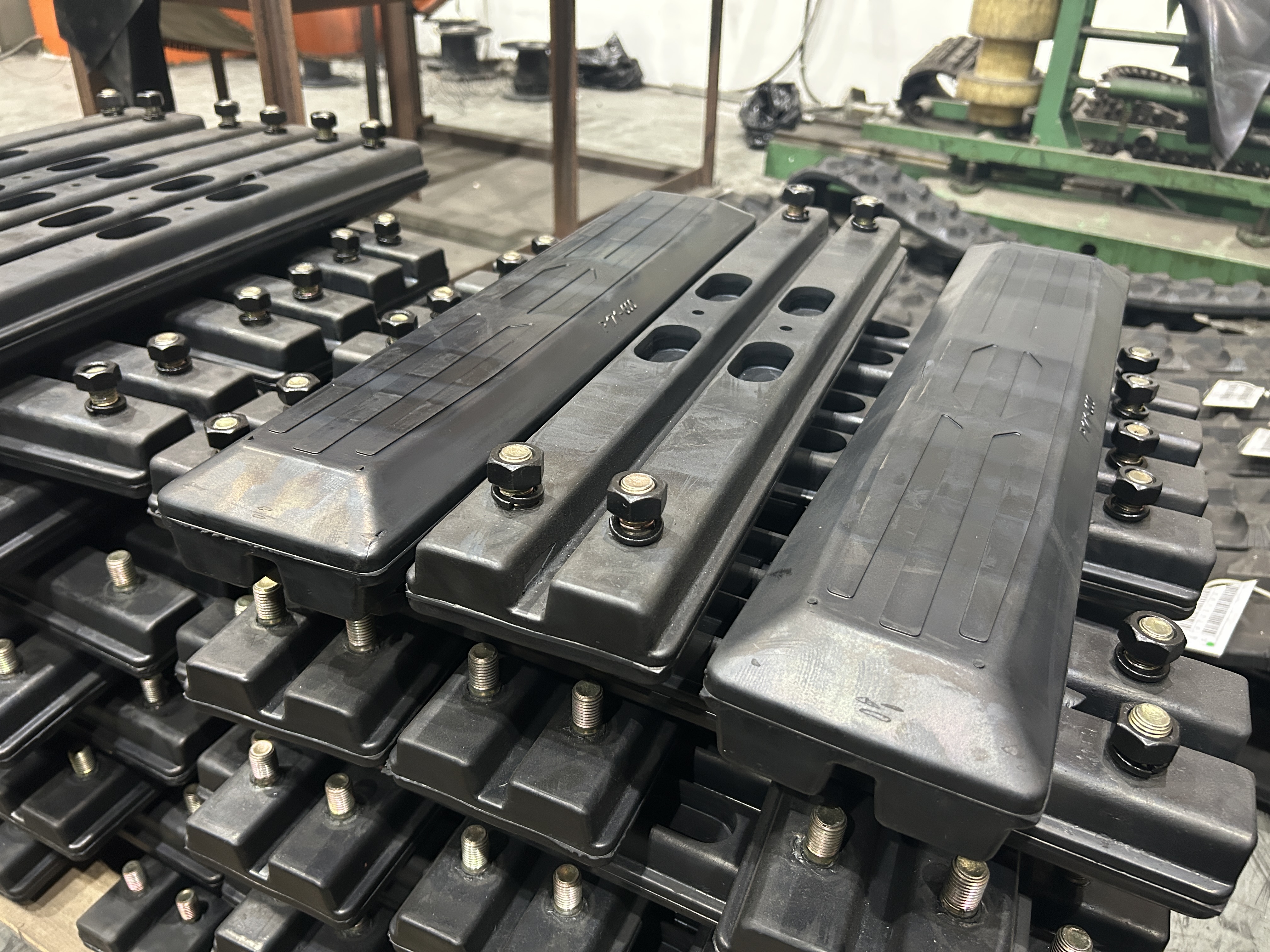
Selecting the appropriate excavator track pads configuration requires a rigorous evaluation of mechanical compatibility, material science, and operational demands. Procurement teams must look beyond initial unit pricing to assess the structural integrity of the pad and its attachment mechanism.
Comparison with Alternative Track Pad Types
The attachment methodology dictates both the durability of the pad and its behavior under heavy lateral loads. Bolt-on pads attach directly through pre-drilled holes in the steel grouser, offering a highly secure fit compared to clip-on alternatives, which rely on wraparound brackets that can deform under stress.
| Pad Configuration | Attachment Method | Lateral Stability | Expected Lifespan (Hours) | Installation Complexity |
|---|---|---|---|---|
| Bolt-On | Bolted through grouser shoe | Excellent | 1,200 – 1,500 | Moderate (requires drilled shoes) |
| Clip-On | Wraparound bracket | Moderate | 800 – 1,000 | Low (fits standard shoes) |
| Chain-On (Roadliner) | Bolted directly to track chain | Excellent | 1,500 – 2,000 | High (replaces steel shoe entirely) |
While clip-on pads offer rapid installation on unmodified steel tracks, bolt-on configurations eliminate the risk of pad slippage during high-torque turning maneuvers, making them the preferred standard for machines exceeding 8 metric tons.
Key Specifications and Material Quality Indicators
The longevity of a bolt-on rubber pad is fundamentally tied to its material specifications and the quality of the rubber-to-metal bonding process. Premium pads utilize a proprietary blend of natural and synthetic virgin rubber, strictly avoiding recycled crumb rubber, which is prone to premature delamination. Industry standards dictate a hardness rating between 75 and 85 Shore A, balancing abrasion resistance with necessary flexibility. Tensile strength is a critical quality indicator; high-performance pads consistently test above 15 MPa. Additionally, the internal steel core must undergo rigorous surface preparation, typically shot blasting followed by the application of advanced bonding agents, to ensure the rubber matrix does not separate from the mounting plate under high shear forces.
Evaluation, Installation, and Standardization
Transitioning a fleet to a bolt-on rubber pad standard involves a systematic evaluation of existing undercarriage assets and the establishment of uniform installation protocols. Standardization minimizes inventory complexity and ensures consistent performance across diverse equipment models.
Sizing and Fitment Best Practices
Accurate sizing is critical to prevent mechanical interference and ensure proper load distribution. Fleet managers must verify the track pitch, shoe width, and the specific bolt-hole pattern of the existing grousers. Common standard widths range from 400 mm for compact equipment up to 600 mm for mid-sized excavators. During installation, adherence to precise torque specifications is non-negotiable. Securing the pads requires torquing the mounting hardware to a standard 120 to 150 Nm, depending on the bolt grade and thread pitch. Under-torquing leads to pad vibration and elongated mounting holes, while over-torquing can induce stress fractures in the internal steel core. Utilizing thread-locking compounds and implementing a mandatory re-torque check after the first 50 hours of operation are highly recommended practices.
Balancing Total Cost of Ownership
The financial justification for standardizing on bolt-on track pads centers on optimizing the Total Cost of Ownership (TCO). While the initial capital expenditure for outfitting a 15-ton excavator with premium bolt-on pads can range from $2,500 to $4,000, the investment yields significant downstream savings. Beyond the elimination of surface repair penalties, the vibration-dampening properties of the rubber pads reduce systemic undercarriage wear. Engineering analyses indicate that utilizing high-quality rubber pads can extend the operational life of lower rollers, idlers, and track chains by 15 to 20 percent. By reducing both unscheduled maintenance events and the long-term degradation of critical undercarriage components, fleets achieve a lower cost per operating hour and higher lifetime asset profitability.
Key Takeaways
- The most important conclusions and rationale for Bolt On Rubber Track Pads
- Specs, compliance, and risk checks worth validating before you commit
- Practical next steps and caveats readers can apply immediately
Frequently Asked Questions
What are bolt-on rubber track pads best used for?
They perform best on asphalt, concrete, and other finished surfaces where steel tracks would mark or damage the ground.
How do bolt-on pads compare with clip-on pads?
Bolt-on pads offer a more secure fit and better lateral stability, especially on heavier machines and during high-torque turns.
Can damaged bolt-on rubber track pads be replaced individually?
Yes. Individual pads can usually be swapped in the field, reducing downtime versus replacing a full rubber track.
How do I choose the correct bolt-on pad for my excavator?
Match the pad to your shoe width, bolt pattern, machine model, and jobsite surface. Gator Track can help confirm fitment.
Does Gator Track supply other excavator pad styles besides bolt-on?
Yes. Gator Track also offers clip-on, chain-on, and multiple replacement pad types for a wide range of equipment.
Post time: May-14-2026