Why Skid Steer Rubber Tracks Are a Strategic Wholesale Category
For distributors, equipment dealers, and heavy machinery procurement teams, replacement undercarriage parts represent a high-turnover, high-margin product segment. Because compact track loaders (CTLs) and multi-terrain loaders operate in unforgiving environments, their tracks act as primary wear items. By securing a reliable wholesale supply of Skid Steer Rubber Tracks, we can capture recurring revenue from fleets requiring frequent maintenance.
Strategic procurement in this category relies on balancing upfront cost with long-term performance. When we invest in high-quality bulk inventory, we are not just buying rubber; we are purchasing uptime for end-users. The wholesale market for these tracks is highly competitive, meaning our ability to source durable, correctly specified products directly dictates our market share and profitability.
Demand across construction, landscaping, agriculture, and rental
We see consistent, year-round demand driven by diverse industries. Construction and demolition sectors require heavy-duty rubber tracks resistant to chunking from rebar and concrete. Landscaping professionals prioritize turf-friendly treads that minimize ground disturbance, while agricultural and rental fleets demand aggressive, all-season traction. Serving these distinct verticals requires us to maintain a versatile, well-rounded inventory.
Why buyers value durability, uptime, and lifecycle cost
For our B2B clients, a snapped track means a halted job site, which translates to thousands of dollars in lost productivity. Therefore, buyers scrutinize the Total Cost of Ownership (TCO) rather than just the initial purchase price. When we provide tracks featuring continuous steel cords and advanced natural-synthetic rubber blends, we directly reduce our clients’ hourly operating costs and maximize machine uptime.
Key commercial factors in wholesale purchasing
Commercially, our success hinges on optimizing landed costs, managing inventory turnover, and securing favorable payment terms from manufacturers. Volume discounts, seasonal ordering incentives, and rebate structures dictate our gross margins. Consequently, we must align our purchasing cycles with regional construction seasons to ensure capital is not tied up in slow-moving stock.
Core Product Specifications for Bulk Buying
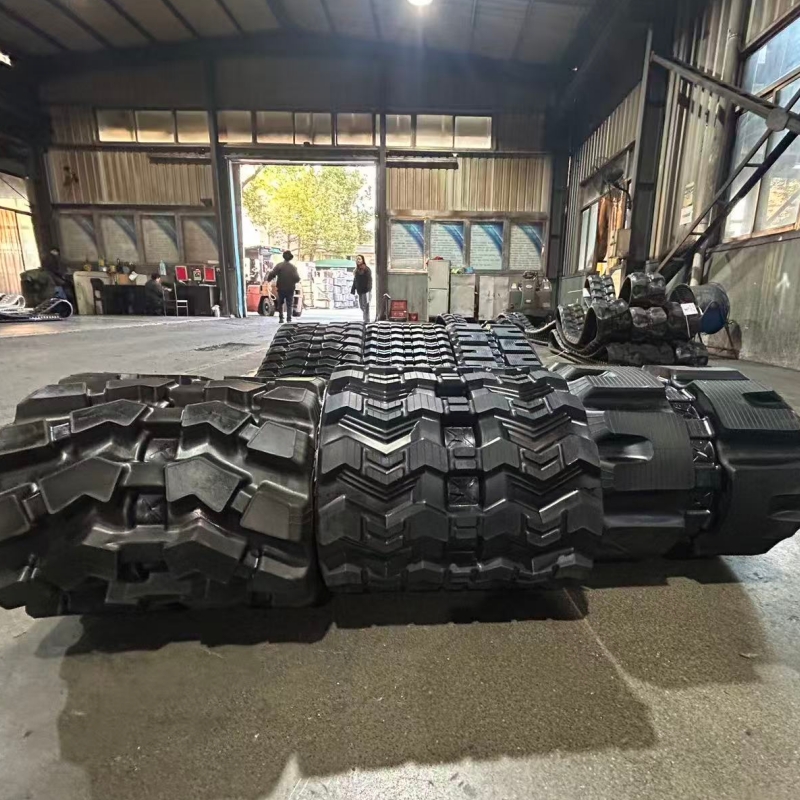
Procuring Skid Steer Rubber Tracks at scale requires an expert understanding of machine specifications. Ordering the wrong pitch or link count results in dead stock and costly return logistics. As buyers, we must rely on accurate cross-reference databases to accurately match aftermarket tracks to OEM machine classes.
Furthermore, internal construction dictates the tier of the product. Premium tracks utilize forged iron cores treated with specialized adhesives to prevent rubber delamination, alongside jointless steel cables that eliminate weak points. Understanding these engineering nuances allows us to confidently position our products against OEM equivalents.
Fitment, machine class, and operating conditions
Accurate fitment is non-negotiable. We must categorize our purchases by machine weight classes and specific undercarriage designs (rigid vs. suspended). Operating conditions dictate our tread selection; a machine working primarily on abrasive asphalt requires a vastly different track profile than one operating in deep mud or snow.
Width, pitch, link count, tread pattern, and compound
The industry standard formula for track sizing is Width (mm) x Pitch (mm) x Link Count. Beyond dimensions, the tread pattern is our primary differentiator.
| Tread Pattern | Best Application | Characteristics |
|---|---|---|
| Block / Staggered | Dirt, Gravel, General Construction | Good traction, smooth ride on hard surfaces |
| C-Lug | Mud, Clay, Soft Soil | High traction, aggressive self-cleaning |
| Zig-Zag | Snow, Ice, Wet Terrain | Maximum grip in slippery conditions |
| Turf / Smooth | Landscaping, Golf Courses | Minimal ground disturbance, low vibration |
OEM-compatible vs aftermarket positioning
We must decide whether to position our inventory as premium OEM-equivalents or cost-effective aftermarket alternatives. Premium positioning yields higher margins and appeals to heavy-duty contractors, while economy tiers are often sufficient for budget-conscious rental yards or light agricultural use.
How to Compare Suppliers and Product Tiers
When evaluating manufacturers for Skid Steer loader Tracks, we must look beyond the Alibaba or trade show facade. A reliable supplier possesses robust in-house compounding capabilities, rigorous tensile testing, and scalable vulcanization presses. We categorize suppliers by their ability to maintain consistent quality across multiple container loads.
The distinction between Tier 1 and Tier 2 suppliers often comes down to raw material ratios. Tier 1 factories utilize a higher percentage of virgin natural rubber blended with specialized synthetic polymers for cut resistance, whereas lower-tier suppliers may over-rely on recycled rubber, drastically reducing the track’s lifespan.
Supplier evaluation criteria
Our evaluation matrix prioritizes manufacturing capacity, financial stability, and historical defect rates. We also assess the supplier’s tooling inventory; a factory that already holds molds for a vast array of machine sizes reduces our lead times and eliminates custom tooling fees.
How to validate durability and field performance
We validate durability through both lab data and field trials. We require suppliers to provide tensile strength reports for their steel cords and abrasion resistance metrics for their rubber compounds. Before committing to a high-volume contract, we typically deploy trial batches to trusted local contractors to monitor real-world wear patterns.
MOQ, customization, private label, and sample policies
Standard Minimum Order Quantities (MOQs) usually start at a 20ft container, though some factories allow mixed pallets for initial orders. We actively seek suppliers offering private labeling (vulcanizing our brand logo into the rubber), which allows us to build brand equity and escape purely price-based competition.
Sourcing, Quality Control, and Compliance Checks
Risk mitigation is the cornerstone of our global sourcing strategy. Because Skid Loader Tracks are heavy and expensive to ship, discovering a manufacturing defect after the container arrives at our warehouse is a catastrophic margin killer. We implement stringent Quality Assurance (QA) protocols at the factory level.
Batch traceability is crucial. Every track must feature a vulcanized serial number that traces back to the exact date, rubber batch, and vulcanization press used. This data is vital for isolating production anomalies and processing warranty claims efficiently.
Factory audits, inspections, and batch traceability
We conduct third-party factory audits focusing on ISO 9001 compliance, worker safety, and machinery maintenance. Pre-shipment inspections (PSI) must verify physical dimensions, weight tolerances, and the absence of visual defects (like surface cracking or exposed cables) before container loading.
Required compliance documents and quality certifications
We mandate that suppliers provide comprehensive documentation, including Certificates of Origin, ISO quality management certificates, and REACH compliance declarations if importing into the European market. These documents prevent customs delays and assure our downstream clients of product safety.
Warranty terms, defect thresholds, and claims handling
A standard B2B warranty covers 12 to 18 months or 1,000 operating hours. We negotiate pro-rated replacement terms and require the supplier to cover the cost of the replacement track on the next container shipment. Our acceptable defect threshold is strictly sub-1%.
Packaging, Shipping, and Inventory Planning
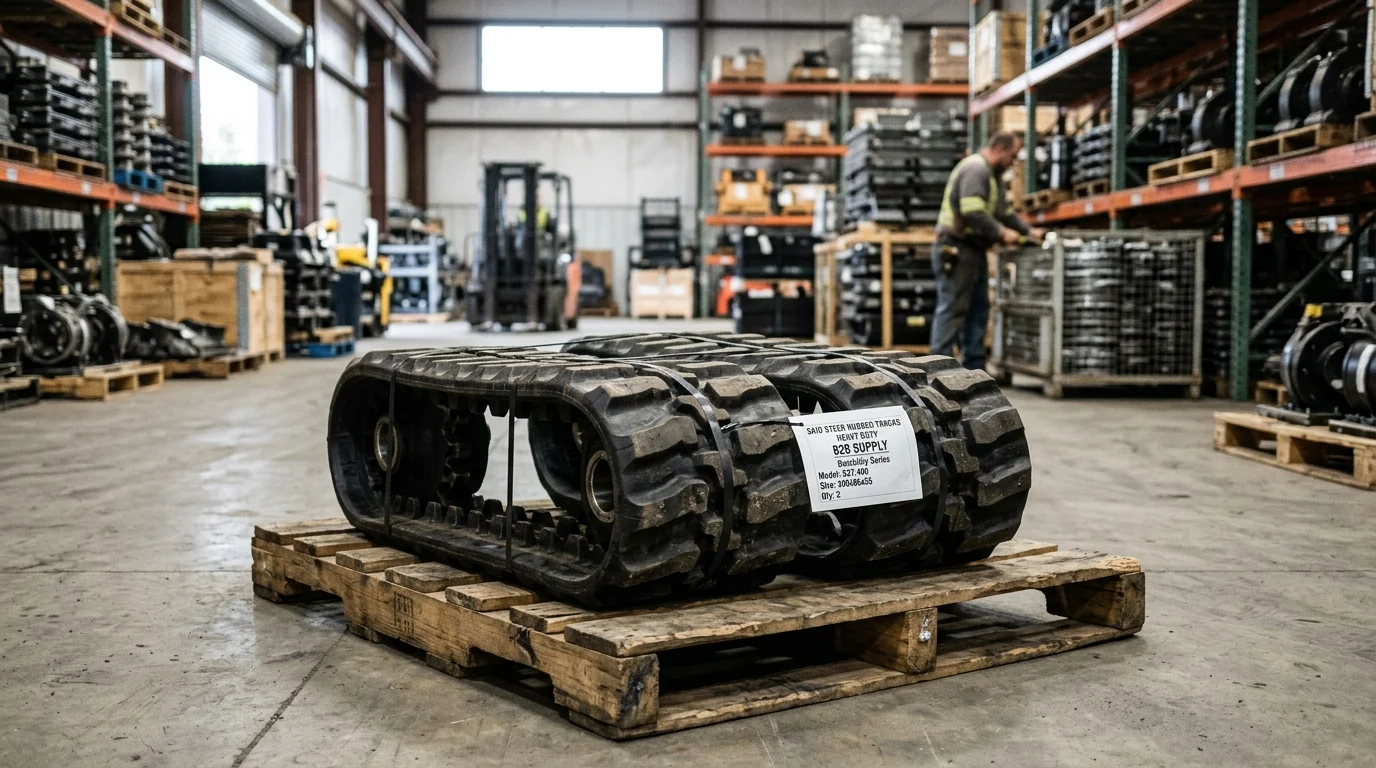
Logistics dictate a massive portion of our final profitability. Rubber tracks are incredibly dense, meaning containers often “weigh out” before they “cube out.” Efficiently packing a container requires strategic mixing of large and small track sizes to maximize the payload without exceeding international weight limits.
Inventory planning requires us to forecast demand accurately to account for oceanic transit times. A stockout during the peak spring construction season results in immediate lost sales, as contractors cannot wait weeks for replacement Skid Steer Rubber Tracks.
Packaging standards for protection and container efficiency
Tracks must be tightly coiled, bound with high-tensile steel strapping, and stacked on custom steel or heavy-duty fumigated wooden pallets. Shrink-wrapping is necessary to prevent UV degradation during transit and warehouse storage.
| Container Size | Approx. Payload Capacity | Typical Track Quantity |
|---|---|---|
| 20ft Standard | 20,000 kg | 100 – 150 pieces (mixed sizes) |
| 40ft High Cube | 26,000 kg (weight limited) | 150 – 220 pieces (mixed sizes) |
Freight, lead times, reorder cycles, and safety stock
Standard lead times from order placement to factory dispatch range from 30 to 45 days, plus an additional 30 days for ocean freight. We maintain a 60-day safety stock of high-velocity sizes (e.g., 320x86x49 and 450x86x55) and utilize automated reorder points based on trailing 90-day sales velocity.
Landed cost factors that affect margin
Our true cost includes the FOB factory price, ocean freight, marine insurance, import duties, and drayage (inland freight). Fluctuations in global shipping rates or anti-dumping tariffs can severely impact our landed cost, requiring agile pricing strategies to protect our margins.
Channel Strategy and Pricing Model
Once inventory is secured, our distribution strategy determines our market penetration. We do not sell directly to end-users; instead, we build a network of regional heavy equipment dealers, independent mechanics, and large rental houses. Each segment requires a tailored value proposition.
By controlling the wholesale distribution of tracks for skid steer, we can implement tiered pricing structures that reward volume and loyalty. Furthermore, offering marketing support and technical training to our dealers helps them sell our tracks more effectively against established OEM brands.
Sales segmentation by dealer, rental, agriculture, and wholesale
Dealers require comprehensive warranties and marketing collateral. Rental houses prioritize absolute durability and low upfront costs to maximize their fleet ROI. Agricultural buyers often purchase seasonally and look for specific tread patterns tailored to soil preservation.
Tiered pricing, rebates, and margin protection
We utilize a tiered pricing model (e.g., Bronze, Silver, Gold) based on annual purchasing volume. To prevent channel conflict, we enforce Minimum Advertised Price (MAP) policies, ensuring our smaller dealers are not undercut by high-volume online retailers.
Private label opportunities for differentiation
Private labeling allows us to launch our own proprietary brand of tracks. By investing in our brand identity, we increase customer loyalty and prevent buyers from simply shopping around for the lowest generic factory price.
B2B Buyer FAQ
As wholesale suppliers, we frequently field technical and commercial inquiries from procurement managers. Anticipating these questions streamlines the onboarding process for new B2B accounts and establishes our authority in the undercarriage market.
Clear communication regarding our operational capabilities, inventory depth, and technical support builds trust. We ensure our sales teams are equipped with precise answers regarding the procurement of Skid Steer Rubber Tracks.
Typical MOQ for wholesale orders
For direct factory shipments, our MOQ is typically one 20ft container. For domestic wholesale distribution from our local warehouses, we generally require a minimum order of two pallets (approx. 4-8 tracks) to qualify for B2B pricing tiers.
How to verify fitment and reduce returns
We provide our B2B partners with proprietary digital cross-reference guides. Buyers simply input the machine make and model, and our system outputs the exact width, pitch, and link count required, drastically reducing costly return freight from misorders.
Expected lead times, warranty, and replacement support
Domestic orders ship within 24-48 hours. We back our premium tracks with an 18-month/1,000-hour pro-rated warranty against manufacturing defects like cable snapping or iron core delamination, supported by a dedicated domestic claims team.
Key Takeaways for Wholesale Selection
Successfully managing a wholesale program for skid steer undercarriage parts requires a holistic approach to procurement. We must look beyond unit price and evaluate the entire supply chain, from the factory’s raw rubber compounding to the final landed cost at our distribution center.
By partnering with top-tier manufacturers and implementing rigorous quality control, we transform a simple rubber commodity into a highly profitable, recurring revenue stream. The ability to consistently deliver durable tracks on time is our ultimate competitive advantage.
Balance specification accuracy, supplier stability, and landed cost
Profitable procurement is a balancing act. We must ensure technical specifications meet our market’s demands, partner with financially stable factories capable of scaling with our growth, and ruthlessly optimize our logistics to maintain a competitive landed cost.
Final criteria for choosing durable, scalable supply
Our final supplier selection rests on transparency, traceability, and technological capability. Factories utilizing continuous steel cord technology and forged iron cores represent the baseline for acceptable B2B durability.
Turning durability into a stronger value proposition
Ultimately, we are selling machine uptime. By educating our downstream channels on the advanced engineering inside our undercarriage products, we shift the conversation away from price and focus on the superior lifecycle ROI our tracks deliver.
Key Takeaways
- Wholesale sourcing and supply-chain implications for skid Steer Loader Tracks
- Specifications, compliance, and commercial terms buyers should validate
- Actionable recommendations for distributors and procurement teams