Introduction
Road construction contractors and equipment buyers are increasingly specifying chain on rubber track pads as a practical replacement for traditional steel shoes, especially on projects that combine excavation, paving, and work on finished surfaces. The change is being driven by tighter urban jobsite requirements, lower tolerance for road damage and noise, and the need for machines to move between rough terrain and paved areas without changing configurations. This report explains how chain on rubber track pads differ from other track pad systems, why they are gaining share in mid-sized fleets, and what B2B purchasers should evaluate in terms of performance, maintenance, operating cost, and application fit.
Why Chain-On Rubber Track Pads Are Replacing Steel
The heavy construction equipment sector is undergoing a significant transition in undercarriage configurations, driven by stricter urban regulations and the necessity for operational versatility. Chain-on rubber track pads, which mount directly to the track chain in place of traditional steel grouser shoes, have emerged as the standard specification for excavators, trenchers, and paving equipment operating in developed environments. This shift reflects a broader industry mandate to balance machine traction with aggressive surface protection across historical districts, municipal utility corridors, and newly paved highways.
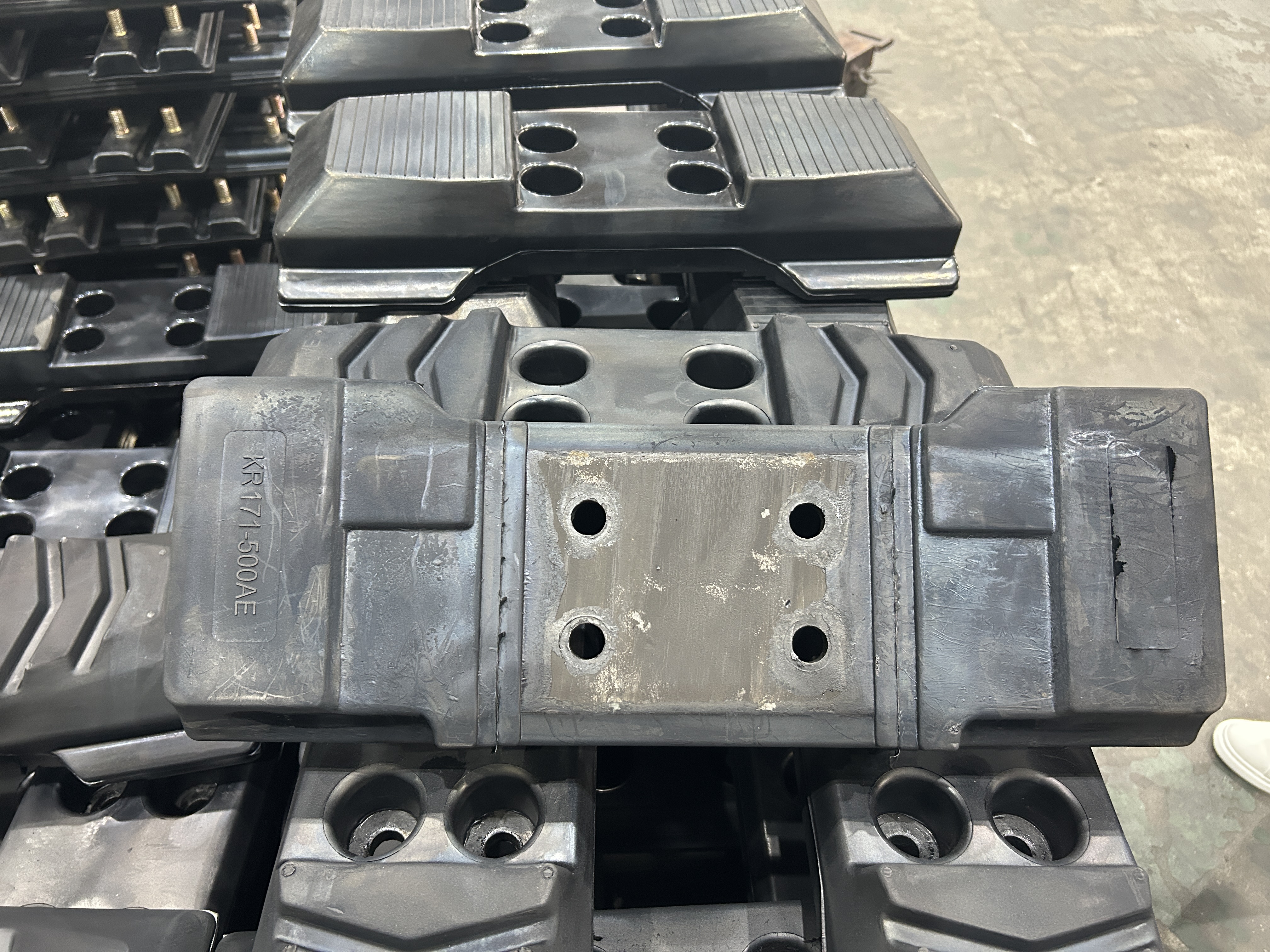
Unlike bolt-on or clip-on variants that attach to existing steel shoes, chain-on pads provide a flush, integrated profile. This design reduces the overall weight of the track group and eliminates the risk of debris accumulation between the pad and the shoe, prompting equipment manufacturers and large-scale contractors to phase out bare steel tracks for mid-sized machinery ranging from 8 to 25 operating tons.
Road Impact and Noise Reduction
The primary catalyst for replacing steel tracks is the mitigation of surface damage on finished asphalt, concrete, and historical cobblestone. Traditional steel grousers exert localized ground pressure that easily fractures pavement, leading to costly remediation. Municipalities increasingly mandate rubber-tracked equipment for utility and roadwork, as repairing damaged asphalt can cost contractors upwards of $30 to $50 per square meter in penalties, labor, and material rework.
Furthermore, chain-on rubber track pads significantly alter the acoustic footprint of heavy machinery. Steel tracks generate high-frequency metal-on-stone clatter and internal pin-to-bushing resonance during transit. High-density rubber dampens this mechanical vibration, reducing operational noise emissions by 5 to 10 decibels (dB(A)). This measurable acoustic reduction is critical for compliance with stringent urban noise ordinances, frequently permitting extended operating hours in residential zones without triggering municipal stop-work orders.
Contractor and Rental Fleet Demand
For fleet managers and heavy equipment rental companies, asset utilization is the core metric of profitability. A machine equipped with bare steel tracks is geographically limited; it must be transported via low-boy trailers even for short distances across paved intersections. Chain-on rubber track pads enable machinery to transition seamlessly from unimproved dirt environments to finished roads under their own power.
This operational flexibility directly impacts the bottom line. Rental fleets report that excavators equipped with chain-on pads experience a 15% to 20% higher utilization rate compared to their purely steel-tracked counterparts. The ability to deploy a single machine for both initial earthmoving and final pavement-adjacent utility work eliminates the need for redundant equipment on site, driving aggressive adoption across major regional and global rental syndicates.
Chain-On Rubber Track Pads vs Traditional Steel
Evaluating chain-on rubber track pads against traditional steel shoes requires a comprehensive analysis of the intended application, ground conditions, and total cost of ownership. While steel remains the undisputed choice for highly abrasive environments such as quarrying, demolition, and deep forestry, engineered rubber pads dominate in mixed-use and urban infrastructure projects where versatility is paramount.
Performance and Lifecycle Comparison
Performance metrics differ vastly between the two materials. Steel shoes offer maximum penetration and traction on loose dirt or steep, rocky inclines but cause unacceptable collateral damage to infrastructure. Chain-on rubber pads provide superior flotation and vibration dampening, yielding a smoother ride that reduces operator fatigue and minimizes shock-related wear on the machine’s internal undercarriage components, such as rollers and idlers.
| Performance Metric | Traditional Steel Shoes | Chain-On Rubber Pads |
|---|---|---|
| Surface Damage Risk | Severe (High ground pressure) | Negligible (Dispersed load) |
| Vibration Transfer | High (Metal-to-ground impact) | Low (Dampened absorption) |
| Typical Lifespan | 3,000 – 4,000 operating hours | 1,500 – 2,500 operating hours |
| TCO in Urban Projects | High (Includes road repair costs) | Low (Eliminates pavement rework) |
| Optimal Application | Quarries, Demolition, Mining | Urban Utility, Paving, Landscaping |
Although steel boasts a longer absolute lifespan, the total cost of ownership for urban contractors heavily favors rubber. The financial savings realized from avoiding surface remediation and expedited job-site mobility rapidly offset the shorter wear cycle of the rubber compound.
Installation, Wear Life, and Compatibility
The installation of chain-on pads involves bolting the steel core of the rubber pad directly to the track chain links using high-tensile track bolts. This direct-to-chain compatibility requires precise matching with standard chain pitches, such as 135mm, 154mm, 190mm, or 216mm. Because they replace the steel shoe entirely, chain-on pads maintain a lower profile and reduce the machine’s center of gravity compared to bolt-on over-shoe alternatives. Proper installation demands that bolts be torqued to strict manufacturer specifications—often between 250 and 400 Nm depending on machine size—to prevent shear forces from compromising the assembly during high-stress pivot turns.
Wear life is highly dependent on operator behavior and the quality of the rubber vulcanization process. Premium chain-on rubber track pads, manufactured with virgin natural rubber blends and reinforced steel cores, reliably deliver 1,500 to 2,500 operating hours. However, repeated exposure to sharp rebar, excessive counter-rotation on abrasive concrete, or harsh chemical spills can accelerate chunking and delamination, necessitating premature replacement.
How B2B Buyers Should Select Chain-On Rubber Track Pads
Procuring durable chain-on rubber track pads requires rigorous supplier vetting and a deep understanding of material specifications. Because visual inspections cannot reveal the internal integrity of the steel core or the chemical composition of the elastomer, B2B buyers must rely on stringent qualification protocols and empirical laboratory performance data.
Sourcing and Supplier Qualification Process
Effective sourcing begins with evaluating the manufacturer’s quality management systems. Buyers should mandate ISO 9001 certification and request documentation on the supplier’s vulcanization and bonding controls. The bond strength between the forged steel core and the rubber over-mold is the most frequent point of failure in sub-par pads; therefore, suppliers must demonstrate advanced adhesive application and precise curing temperature logs.
Logistics and production scale also dictate supplier selection, ensuring consistent availability and reliable inventory for fleet-wide replacements.
Key Takeaways
- The most important conclusions and rationale for Chain On Rubber Track Pads
- Specs, compliance, and risk checks worth validating before you commit
- Practical next steps and caveats readers can apply immediately
Frequently Asked Questions
Why are chain-on rubber track pads replacing traditional steel shoes?
They protect asphalt and concrete, cut noise, and let machines move between dirt and paved areas without damaging finished surfaces.
When should I choose chain-on pads instead of steel shoes?
Use chain-on pads for urban roadwork, utility corridors, paving, and residential jobs. Keep steel shoes for quarrying, demolition, or very abrasive rocky ground.
Do chain-on rubber track pads fit many excavator models?
Yes. Gator Track supplies chain-on excavator pad options across multiple fitment sizes and model codes; confirm your machine model and chain dimensions before ordering.
How long do chain-on rubber track pads typically last?
They commonly last about 1,500 to 2,500 operating hours, depending on load, surface conditions, travel distance, and maintenance practices.
Can Gator Track provide other pad styles if chain-on is not ideal?
Yes. Gator Track also offers bolt-on, clip-on, and replacement pad variants like RP, HXP, and DRP for different undercarriage setups and job conditions.

Post time: Jun-08-2026