Why Dumper and ASV Track Specifications Matter
When managing earthmoving operations on demanding H2 (hydrogen infrastructure) construction sites, standardizing undercarriage components is a requirement for maintaining uptime. The specifications of deployed tracks directly dictate equipment traction, fuel efficiency, and overall safety. Operating heavy machinery in these hazardous environments—where ATEX zoning requirements and thermal contraction or ground heave from cryogenic exposure introduce unique risks—means that a track failure represents a significant safety hazard and a costly operational bottleneck. Depending on the fleet, every hour of downtime on an active H2 site can result in substantial financial losses, making undercarriage reliability paramount to project budgets. Furthermore, H2 sites require strict spark mitigation and anti-static compliance, meaning track selection must align with broader site safety protocols.
Key Track Types and Use Cases
Distinguishing between standard heavy-duty tracks and specialized ASV Tracks is the first step in optimizing site logistics. It is critical to understand that these are not interchangeable procurement options; track choice is dictated by the machine category. ASV tracks are proprietary to ASV compact track loaders, utilizing a Posi-Track system with a non-metal core and internal aramid or poly-cord reinforcement. This non-metal architecture inherently aids in spark mitigation—a crucial benefit in H2 environments—and allows ASV machinery to operate at higher OEM-specified travel speeds without the harmful vibration associated with steel-embedded tracks. However, operators must account for the fact that aramid cores behave differently under sustained static loads compared to steel cords, making them susceptible to compression set or permanent deformation if parked heavily loaded for extended periods.
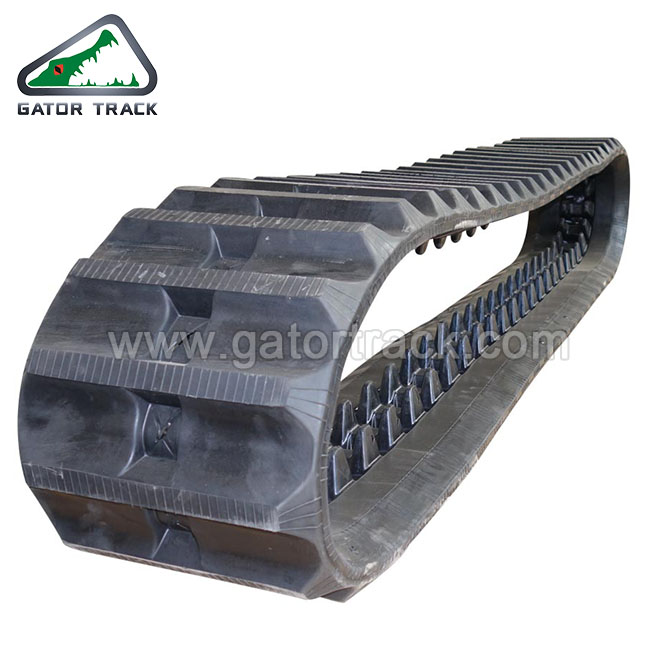
Conversely, traditional Dumper Rubber Tracks are designed specifically for tracked dumpers across multiple OEMs. They rely on continuous steel cords and forged metal links to support massive payload capacities, prioritizing load distribution over high-speed agility. These heavy dumper units operate at lower maximum speeds, requiring a rigid steel skeleton to prevent derailing under extreme lateral loads.
Site Conditions That Affect Performance and Risk
The specific topography and environmental hazards of an H2 site dictate risk mitigation strategies. For instance, operating on jagged shale or demolition debris accelerates rubber chunking and abrasive wear. Fleet-specific maintenance observations often reveal that using a standard continuous-duty track on highly abrasive terrain may reduce its functional lifespan significantly. Operators should specify tracks with anti-static properties suited for ATEX zones to combat this wear and prevent static buildup. However, it is vital to note that track selection alone does not make a machine ATEX-compliant; whole-machine certification, proper grounding, and spark-resistant undercarriage designs are strictly required on H2 sites. Furthermore, steep inclines exceeding a 30-degree grade demand aggressive tread patterns, like a staggered block or zig-zag tread, to prevent slippage when hauling a full payload.
Specifications to Compare Before Buying

Before issuing a purchase order, procurement teams should meticulously compare technical specifications rather than simply relying on OEM model numbers. Navigating the aftermarket landscape requires looking beyond basic compatibility. Buyers must examine the internal architecture, as the core construction governs the track’s elongation resistance and structural integrity.
Tread Pattern, Size, and Fit
The fundamental fitment formula relies on three critical dimensions: overall width, pitch (the center-to-center distance between metal links), and the total number of links. Dumper track dimensions must always be matched to specific OEM machine models rather than general equipment categories. A mismatch of even a few millimeters in pitch can cause accelerated sprocket wear and inevitable track snapping. Below is a comparative breakdown of typical specifications evaluated when outfitting a fleet:
| Specification Category | Heavy-Duty Dumper Tracks | High-Speed ASV Tracks |
|---|---|---|
| Core Construction | Continuous steel cords & forged iron links | Aramid/Kevlar belting, non-metal core |
| Typical Width Range | 320mm – 800mm | 280mm – 510mm (11″ – 20″) |
| Pitch Dimensions | 86mm, 100mm, 150mm | Proprietary drive lug spacing |
| Equipment Travel Speed | Lower OEM-specific maximums | Higher OEM-specific maximums |
| Primary Optimization | Max payload & puncture resistance | Flotation & low ground disturbance |
Selecting the correct tread pattern—such as a C-lug for aggressive mud traction or a straight-bar lug for hardpack—directly influences cycle times and fuel consumption.
Load, Ground Pressure, Traction, Heat, and Chemical Resistance
Load capacity and ground pressure are intrinsically linked to a site’s soil composition. When deploying ASV compact track loaders on soft turf or muddy subgrades, a low ground pressure profile is required to maintain flotation and prevent the machine from burying itself. In contrast, tracked dumpers exert significantly higher ground pressure when fully loaded, necessitating heavy-duty continuous steel cables to bear the gross operating weight. Proper track tension adjustment is a critical operational caveat to support these heavy loads without premature wear.
Furthermore, in environments exposed to extreme heat, cryogenic liquid spills, or chemical runoff, operators should specify tracks formulated with specialized synthetic virgin rubber compounds rather than recycled blends. High-temperature environments can degrade standard rubber, accelerating thermal breakdown if the internal operating temperature exceeds safe OEM limits during continuous tramming. Conversely, exposure to cryogenic hydrogen can cause sudden rubber embrittlement, making specialized compound selection critical for H2 site safety.
How to Source, Inspect, and Choose Tracks
Sourcing the right aftermarket tracks requires a disciplined approach to vendor qualification and physical inspection upon delivery. These components cannot be treated as generic commodities. Implementing a strict procurement protocol ensures that every mounted track meets essential safety and performance benchmarks.
Measurement and Procurement Checklist
A rigorous measurement and inspection checklist should be mandated before any track is fitted to a machine. First, technicians must verify the stamped dimensions (Width x Pitch x Links) against the purchase order to ensure strict OEM tolerance adherence. Next, inspect the rubber for vulcanization defects, looking closely for micro-cracking around the iron core links or drive lugs. A thorough durometer test on the rubber lugs should ideally yield a hardness rating between 60 and 65 Shore A, though operators must remember that Shore A hardness varies by season and ambient temperature.
Key Takeaways
- Match track type to the machine category, because ASV Rubber tracks are proprietary to ASV compact track loaders while dumper tracks are built for tracked dumpers.
- Specify anti-static and spark-mitigating track properties for H2 and ATEX-risk areas, but verify whole-machine compliance before deployment.
- Use steel-cord dumper tracks for heavy payload hauling where load distribution, rigidity, and derailment resistance are more important than high travel speed.
- Select aggressive tread patterns such as staggered block or zig-zag designs when operating loaded equipment on grades near or above 30 degrees.
- Avoid parking heavily loaded ASV machines for extended periods, because aramid-reinforced tracks can develop compression set under sustained static loads.
- Assess terrain hazards such as shale, demolition debris, and abrasive ground before purchasing tracks to reduce chunking, premature wear, and unplanned downtime.
Frequently Asked Questions
Why do track specifications matter on hydrogen construction sites?
Track specifications affect traction, downtime, fuel efficiency, and safety. On H2 sites, they also need to support spark mitigation, anti-static controls, and reliable operation around ATEX-zoned or cryogenic-exposed areas.
Are dumper tracks and ASV tracks interchangeable?
No. ASV tracks are built for ASV compact track loaders using the Posi-Track system, while dumper tracks are designed for tracked dumpers and heavy payload transport across multiple OEM platforms.
What makes ASV tracks useful in spark-sensitive environments?
ASV tracks commonly use a non-metal core with aramid or poly-cord reinforcement, which helps reduce spark risk compared with steel-embedded designs. However, the whole machine still needs proper site compliance.
When are steel-cord dumper tracks the better choice?
Steel-cord dumper tracks are better for heavy payloads, low-speed hauling, and extreme lateral loads because their rigid internal structure improves load distribution and derailment resistance.
Can track selection alone make equipment ATEX-compliant?
No. Anti-static or spark-mitigating tracks are only one part of site safety. ATEX compliance also depends on whole-machine certification, grounding, maintenance controls, and spark-resistant undercarriage design.
Post time: Aug-11-2026