Why Rubber Excavator Tracks Matter in Procurement
As global infrastructure initiatives expand, there is a substantial shift in how fleet managers and procurement specialists specify heavy equipment undercarriage components. Spurred by massive capital injections—such as the $1.2 trillion infrastructure bill in the United States and similar urban renewal funds across Europe—the demand for compact and mid-sized construction equipment is reaching historic highs.
For heavy machinery supply chains, the transition toward versatile undercarriage solutions is no longer just a preference but an increasingly important compliance and operational choice. While steel tracks remain viable and common for open or rough terrain, urbanization demands machinery that can operate efficiently in sensitive environments without destroying existing infrastructure or violating stringent environmental mandates, placing a renewed spotlight on rubber tracks.
Key Performance and Market Drivers
The primary catalyst for this shift is the tightening of noise and surface damage regulations. For instance, while European Directive 2000/14/EC governs guaranteed machinery sound power levels at the manufacturing stage, local municipal noise ordinances routinely restrict equipment operating noise to strict decibel limits in residential zones. Traditional steel undercarriages often exceed these acoustic limits, whereas modern rubber alternatives dampen vibration and reduce acoustic output significantly.
Furthermore, the market for mini and midi excavators—specifically those in the 1.5 to 10-ton operating weight classes—has grown by an estimated 12% annually in North America and Europe between 2018 and 2023, according to industry market analyses. This growth directly pulls the demand for rubber track manufacturing. Beyond noise compliance, these tracks can reduce whole-body vibration for the operator by up to 30% compared to steel, based on leading manufacturer claims, though actual reductions vary by brand and application. This directly improves operator endurance and meets stricter occupational health and safety standards.
When Rubber Tracks Are the Best Fit
Specifying rubber over steel is highly recommended when the job site involves finished surfaces such as asphalt, concrete, or established landscaping. A standard rubber track on a 3-to-5 ton machine exerts a ground pressure of roughly 3.5 to 5.0 PSI—depending heavily on exact machine weight and track contact area—allowing heavy machinery to traverse fragile infrastructure without causing localized fracturing. This prevents projects from incurring unexpected surface remediation costs, which can easily exceed $10,000 in municipal fines or repair bills on a single urban job site.
Additionally, these tracks are typically 15% to 20% lighter than their steel counterparts. This weight reduction lowers the machine’s overall ground bearing pressure while maintaining the necessary breakout force and stability required for demanding excavations. However, rubber tracks are not universally suitable and have distinct limitations. To maximize lifespan and prevent premature failure, they should be carefully managed or avoided in the following scenarios:
- High-Friction Maneuvers: Sharp pivot turns on hot asphalt or concrete can cause scuffing and tearing, requiring operators to use careful maneuvering techniques to avoid surface damage.
- Sharp Rocky Terrain: Jagged surfaces can easily slice the rubber casing and expose internal steel cords to moisture and rust.
- High-Heat Environments: Sustained surface temperatures above 50°C (122°F), such as those found in active demolition sites, accelerate rubber degradation.
- Chemical Exposure: Environments with heavy exposure to hydraulic fluid, diesel, and industrial solvents rapidly break down the rubber compound.
In these specific scenarios, steel tracks remain the superior choice.
How to Compare Rubber Excavator Tracks
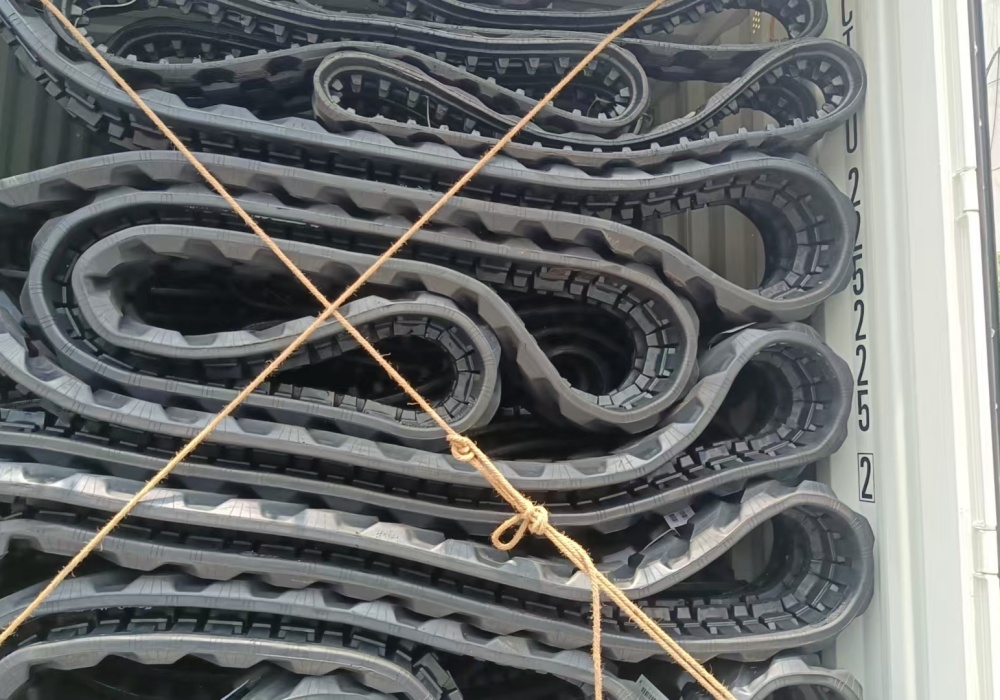
Evaluating and selecting the right undercarriage components requires looking beyond basic dimensional compatibility. Not all rubber blends or internal steel structures yield the same operational lifespan, making rigorous specification analysis critical to a successful sourcing strategy.
To maximize return on investment, project engineers and buyers must evaluate the internal construction of the tracks, focusing heavily on tensile strength, tread depth, and the chemical composition of the rubber itself.
Core Specifications to Evaluate
When assessing Rubber Excavator Tracks against industry benchmarks, the primary focus should be on pitch, width, link count, and internal architecture. Buyers must ensure that pitch, width, and link count match OEM undercarriage specifications exactly; any dimensional mismatch will cause immediate operational failure regardless of track grade. The industry standard has definitively shifted toward Continuous Steel Cord (CSC) technology. Unlike older overlapping cord designs, CSC eliminates the weakest point in the track loop, increasing overall tensile strength by up to 40% in certain manufacturer-specific designs and drastically reducing the risk of snapping under high torque.
Tread patterns and depth are also critical, typically ranging from 25mm to 30mm on new units. C-lug patterns provide superior traction in muddy terrain, while staggered block patterns offer smoother rides on hard surfaces. The following baseline parameters are useful when comparing standard and premium tracks. Note that categories like “Standard” and “Premium/Heavy-Duty” are not standardized across the industry, and actual specifications will vary by manufacturer and region:
| Specification | Illustrative Standard Track | Illustrative Premium Track |
|---|---|---|
| Internal Structure | Overlapping Steel Cords | Continuous Steel Cords (CSC) |
| Rubber Blend | High Synthetic (Lower Cost) | Natural/Synthetic Blend (~60/40) |
| Tensile Strength | ~15 MPa | 20+ MPa |
| Tread Depth | 20mm – 25mm | 25mm – 32mm |
| Average Lifespan | ~1,000 – 1,500 Hours | ~2,000 – 2,500+ Hours |
Performance, Durability, and Lifecycle Cost
The chemical composition of the tread heavily dictates lifecycle costs. A highly optimized natural-to-synthetic rubber ratio—often cited by manufacturers as a 60/40 blend—provides the necessary elasticity to prevent chunking while maintaining resistance to abrasive surfaces. Tracks with too much synthetic rubber tend to harden and crack under UV exposure, while too much natural rubber degrades quickly upon contact with petroleum-based job site spills.
From a financial perspective, relying on Total Cost of Ownership (TCO) metrics rather than upfront pricing is essential. Using illustrative examples rather than market-wide benchmarks, if a standard track costs $1,200 and lasts 1,200 hours, the base operational cost is $1.00 per hour.
How to Source and Deploy Rubber Excavator Tracks
When I advise international procurement teams on upgrading heavy machinery, securing reliable rubber excavator tracks requires a strict vetting and deployment protocol. The global supply chain demands rigorous oversight to ensure operational longevity and maximize return on investment.
Supplier Verification and Quality Checks
To avoid costly machinery downtime, I recommend auditing manufacturers against internationally recognized benchmarks. We must verify ISO 9001 compliance to ensure manufacturing consistency across bulk orders. A critical quality check involves requesting material data sheets to confirm the specific ratio of natural to synthetic rubber, as this formulation dictates the track’s tear resistance and UV durability.
Furthermore, I always demand batch testing reports on the internal steel cord technology. Procurement teams should exclusively source tracks utilizing continuous steel cord construction; legacy designs with overlapping steel cords are highly susceptible to snapping under high-torque excavation loads.
Installation, Maintenance, and Final Selection
Selecting the optimal tread pattern—such as a C-lug for muddy terrain or a staggered block pattern for hard, paved surfaces—is just the first step in deployment. Once the rubber excavator tracks arrive, proper installation dictates the machinery’s lifecycle. I train maintenance crews to clean the undercarriage thoroughly and inspect the sprockets, idlers, and bottom rollers for uneven wear before mounting new tracks, as worn undercarriage components will rapidly degrade new rubber.
Post-installation maintenance must follow a strict operational schedule. Proper track tensioning is paramount; over-tensioning tears the rubber and destroys bearings, while under-tensioning inevitably leads to de-tracking.
| Maintenance Task | Frequency | Objective |
|---|---|---|
| Tension Calibration | Every 50–100 hours | Prevent de-tracking and internal cord snapping |
| Undercarriage Cleaning | Daily | Remove abrasive debris (rocks, hardened mud) |
| Tread Depth Inspection | Monthly | Monitor uniform wear and forecast replacement cycles |
By treating sourcing and deployment as a unified, data-driven process, fleet managers can drastically extend the service life of their tracks while maintaining peak excavation efficiency.
Key Takeaways
- Specify rubber excavator tracks for urban, residential, asphalt, concrete, or landscaped job sites where surface protection and lower noise are procurement priorities.
- Evaluate rubber tracks for 1.5 to 10-ton mini and midi excavators, a segment that grew by an estimated 12% annually in North America and Europe from 2018 to 2023.
- Use rubber tracks to reduce operator vibration, with some manufacturers claiming reductions of up to 30% compared with steel undercarriages.
- Factor potential surface remediation costs into procurement decisions, since damage-related fines or repairs can exceed $10,000 on a single municipal project.
- Avoid sharp pivot turns and jagged rocky terrain when operating rubber tracks to prevent scuffing, casing cuts, and premature exposure of internal steel cords.
Frequently Asked Questions
Why are excavator tracks gaining attention in construction procurement?
Infrastructure spending, urban renewal, and growth in compact excavators are increasing demand for tracks that reduce noise, vibration, and surface damage on sensitive job sites.
When are rubber tracks a better choice than steel tracks?
Rubber tracks are best for asphalt, concrete, landscaping, residential zones, and urban projects where minimizing surface damage, noise, and ground pressure is important.
How much can rubber tracks reduce operator vibration?
Leading manufacturer claims suggest rubber tracks can reduce whole-body vibration by up to 30% compared with steel tracks, though results vary by machine, brand, terrain, and operating style.
What excavator sizes are driving rubber track demand?
Mini and midi excavators in the 1.5 to 10-ton range are a major driver, with industry analyses estimating about 12% annual growth in North America and Europe from 2018 to 2023.
Can rubber tracks help avoid surface repair costs?
Yes. On finished urban surfaces, rubber tracks can reduce localized cracking and damage, helping contractors avoid repair bills or municipal penalties that may exceed $10,000 on a single job.

Post time: Sep-02-2026