A skid steer’s tracks are more than a wear item—they are a direct line item in fleet profitability. For contractors running machines in high-cycle construction, landscaping, demolition, or site-prep work, a failed track can mean lost production, idle labor, rush freight, and a disrupted schedule. That is why more fleet managers are looking beyond the lowest purchase price and evaluating cost per hour, replacement intervals, and failure risk. Premium rubber tracks typically bring stronger internal construction, improved compounds, and longer service potential, but they still depend on correct sizing and maintenance. This article explains how track quality affects uptime, lifecycle cost, and smarter purchasing decisions.
Why Fleet Managers Choose Premium Skid Steer Tracks
Industry benchmarks suggest the undercarriage represents a substantial portion of a skid steer’s total maintenance budget. When operating in high-cycle environments, minimizing downtime is critical to maintaining profitability. Recently, there has been a significant industry shift: fleet managers are increasingly abandoning standard economy components in favor of premium alternatives to optimize long-term budgets. It is important to note that “premium” and “standard” are market descriptors denoting price and quality tiers—often separating aftermarket economy options from OEM-grade replacements—rather than regulated industry categories.
Premium vs Standard Track Differences
The primary distinction between standard and premium variants lies in their internal architecture. While construction methods vary by supplier and price tier, entry-level economy tracks often utilize overlapping steel cords, which can create inherent weak points susceptible to snapping under heavy torque. Conversely, higher-tier skid steer tracks frequently feature continuous steel cord technology wound or braided from high-tensile steel. Manufacturer specifications indicate this continuous design eliminates the overlapping joint, effectively increasing the track’s overall tensile strength.
Furthermore, rubber compounds differ significantly across tiers. While synthetic blends often outperform natural rubber in oil resistance and heat tolerance, many premium options utilize virgin natural rubber compounds to maximize resistance to chunking and edge cutting in general dirt and rock applications. Depending on the manufacturer, terrain, and application, illustrative ranges suggest standard tracks may require replacement around the 800 to 1,000-hour mark, whereas premium tracks can often push past 1,500 to 2,000 hours. However, these lifespans depend heavily on strict tension maintenance, proper undercarriage alignment, and operator skill—factors that can easily override the benefits of a premium track if neglected.
Operating Costs Affected by Track Choice
It is easy to balk at a premium track’s higher initial purchase price. However, operating costs drop substantially when analyzing the total cost of ownership. Unplanned downtime in commercial construction carries heavy financial penalties in lost productivity and operator wages.
For example, a concrete total-cost-of-ownership calculation for a high-cycle machine must quantify not just the initial parts invoice, but also the lost productivity (often exceeding $100 per hour), idle operator wages, emergency freight charges, and replacement labor. By extending the replacement interval, fleets can often eliminate at least one mid-season track failure per machine. When factoring in these avoided labor and downtime costs, the true cost per hour of operation drops noticeably with premium tracks.
How to Compare Track Options
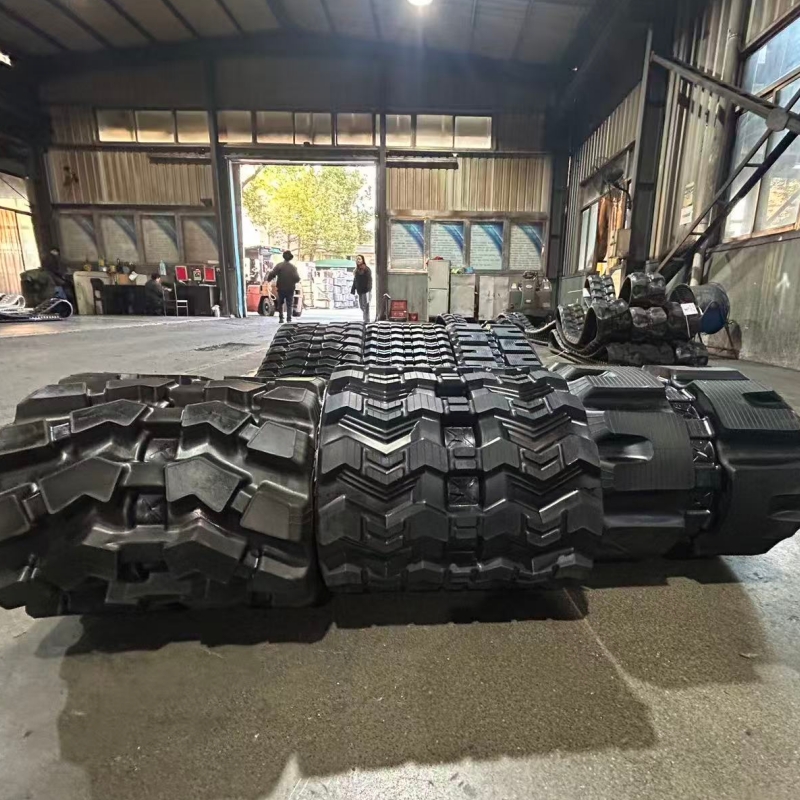
When evaluating replacements for skid steers, comparing track options requires looking past the initial price tag and digging deeply into the engineering specifications. Understanding how different builds react to operational stress is the key to maximizing tread life.
Key Specs and Durability Factors
To make an informed decision, operators should closely examine key specifications such as pitch, width, and link count—which refers to the rubber track lugs rather than steel chain links, preventing confusion with steel undercarriage components. For instance, a standard 320x86x49 track must precisely match the machine’s undercarriage geometry to prevent derailment. Durability is heavily influenced by the internal cabling, carcass thickness, and the rubber compound’s durometer rating. Premium tracks typically feature a thicker carcass and embedded core bars that resist bending under a machine’s full operating weight.
| Specification |
Economy Market Tier |
Premium Market Tier* |
| Carcass Thickness |
Standard |
Enhanced / Thicker |
| Core Bars |
Basic |
Heavy-Duty Embedded |
| Rubber Durometer |
General Purpose |
Application-Specific |
| Illustrative Warranty |
6 – 12 months |
18 – 24 months |
*Specifications and warranties reflect general market trends and vary by specific manufacturer.
By comparing these structural factors side-by-side, it becomes clear why the enhanced integrity of a premium track withstands aggressive maneuvering much better than economy options.
Traction, Ride Quality, and Wear Trade-Offs
Track selection also involves balancing traction, ride quality, and wear rates. Different tread patterns serve entirely different operational profiles. For example, a C-lug pattern offers a remarkably smooth ride on hard surfaces like concrete, reducing operator fatigue and minimizing vibration damage to the machine’s sensitive electronics.
However, in deep mud, a staggered block or zig-zag tread pattern can provide significantly more tractive effort. The trade-off is that aggressive zig-zag patterns are observed to wear down faster when driven extensively on abrasive asphalt. Carefully matching the lug pattern to the site condition ensures fleets do not sacrifice track life for unnecessary traction on flat, hard-packed surfaces.
While comparing technical specifications narrows down the build quality, selecting the exact premium track depends heavily on mapping the machine’s primary daily tasks. Auditing a fleet’s operating environments and utilization rates is essential before finalizing any procurement decisions.
Application Fit and Supplier Quality
The most crucial step is ensuring the track’s tread and rubber compound fit the application perfectly. A landscaping skid steer operating on turf requires a smooth, multi-bar tread to prevent surface tearing, whereas a demolition unit needs severe-duty tracks with thick carcasses to resist rebar punctures.
Beyond application fit, scrutinizing supplier quality is vital. Reputable OEM and aftermarket manufacturers often maintain ISO 9001 certification and offer transparent quality control data, keeping defect rates to an absolute minimum. A supplier offering a 24-month or 2,000-hour non-prorated warranty demonstrates strong confidence in their manufacturing process, providing peace of mind when outfitting multiple machines.
When Premium Tracks Justify the Cost
While premium components offer distinct advantages, they are not a universal requirement for every machine in a fleet. Specific utilization thresholds help justify the investment without overspending on low-use equipment. If a specific skid steer logs high annual hours in harsh environments like recycling yards or commercial development sites, the return on investment for a premium track is typically realized much faster.
Conversely, for a utility machine that runs fewer than 200 hours annually for light yard cleanup, a standard track is often sufficient to meet the operational demands. Ultimately, the goal is to minimize the total cost per hour.
Key Takeaways
- Compare tracks by total cost per operating hour, not just upfront purchase price, because downtime, labor, and emergency replacement costs can exceed the invoice difference.
- Premium skid steer tracks may last 1,500 to 2,000 hours in suitable conditions, compared with roughly 800 to 1,000 hours for many standard options.
- Look for continuous high-tensile steel cord construction because it removes overlapping cord joints that can become weak points under heavy torque.
- Match pitch, width, and link count exactly to the skid steer undercarriage to reduce the risk of derailment and premature wear.
- Maintain correct track tension, undercarriage alignment, and operator discipline because poor maintenance can erase the durability advantage of premium tracks.
Frequently Asked Questions
Premium tracks can reduce cost per operating hour by lasting longer, lowering downtime risk, and avoiding emergency freight, labor, and idle operator costs.
How long do premium skid steer tracks typically last?
Depending on terrain, maintenance, and operator habits, premium tracks may reach about 1,500 to 2,000 hours, while standard tracks often need replacement around 800 to 1,000 hours.
What makes premium tracks more durable than standard tracks?
Many premium tracks use continuous high-tensile steel cords and higher-quality rubber compounds, which help reduce weak points, improve tensile strength, and resist chunking or edge cutting.
Are premium tracks always the best choice for every skid steer?
Not always. Premium tracks deliver the most value in high-cycle, commercial, rocky, or abrasive applications where downtime is expensive and replacement intervals matter.
What specifications should fleet managers check before buying tracks?
Confirm pitch, width, and link count match the machine exactly, such as a 320x86x49 configuration, to prevent poor fit, premature wear, or derailment.