ASV Tracks vs Dumper Rubber Tracks
When operating heavy equipment on delicate surfaces like turf, soft clay, or marshland, selecting the right machinery and undercarriage components is paramount. Operators frequently face a critical choice between specialized track systems designed for minimal ground disturbance and those built for heavy material transport. Crucially, ASV tracks and dumper rubber tracks serve entirely different machine categories—compact track loaders (CTLs, typically weighing 3,000 to 12,000 lbs) versus tracked carriers or dumpers (handling payloads from 1,000 to over 20,000 lbs). Therefore, the real decision is selecting the appropriate equipment class for the site, rather than treating these tracks as interchangeable options on a single chassis. Understanding the structural and operational nuances between these two categories ensures maximum machine uptime while protecting the terrain.
Definitions and Key Differences
To make an informed decision, it is necessary to define the core characteristics of each track type. ASV Tracks refer specifically to the proprietary Posi-Track undercarriage system originally developed by the ASV brand for compact track loaders, rather than a generic track category. Unlike traditional rubber tracks, they utilize a non-metal core, relying instead on high-tensile poly-cord or Kevlar belting. This construction reduces track weight by approximately 15% to 20% compared to steel-core equivalents, making them exceptionally flexible and allowing the track to conform seamlessly to uneven terrain.
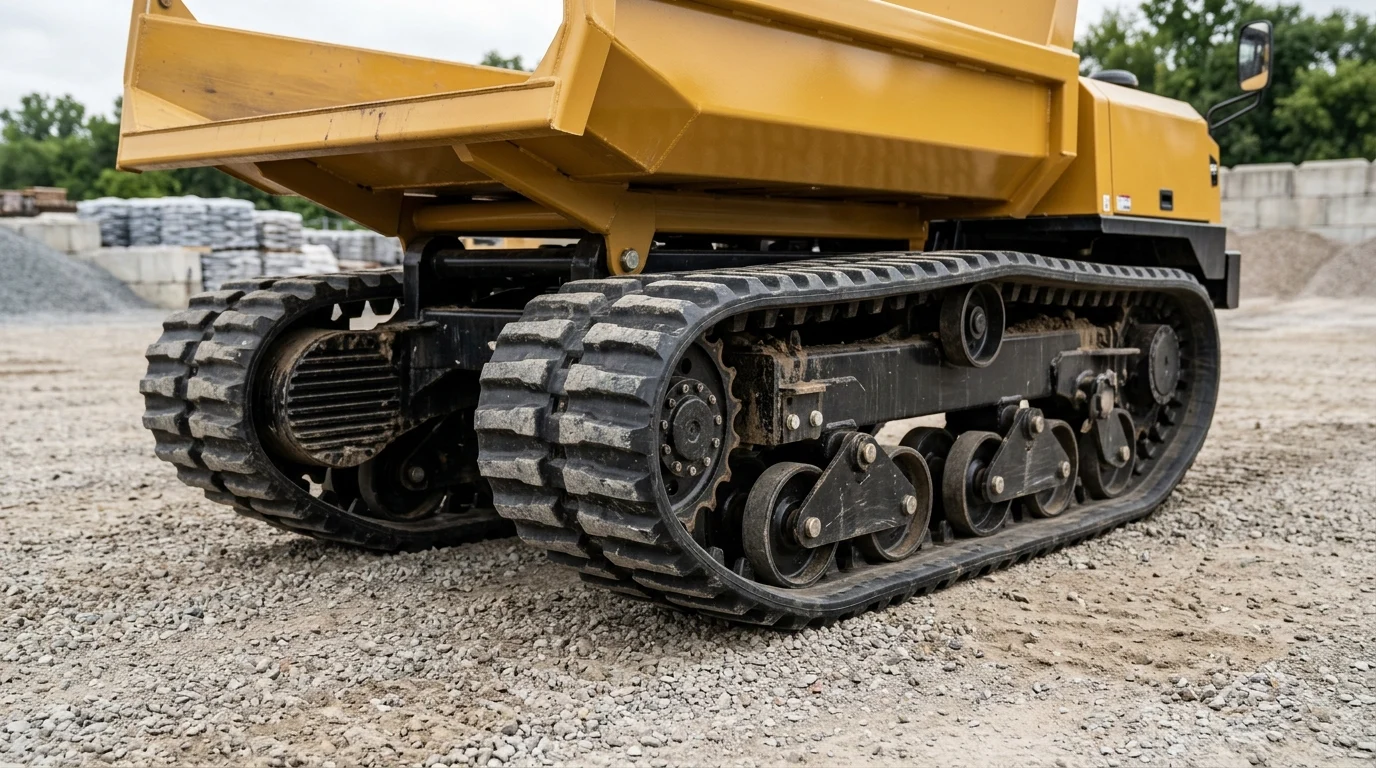
Conversely, Dumper rubber tracks are built for tracked carriers and motorized wheelbarrows tasked with moving dense materials. These tracks typically feature a continuous steel cord and embedded forged metal cores to support massive payloads (often exceeding 5 to 10 tons in heavy commercial dumpers) without snapping or deforming under stress. Premium manufacturers often utilize a 50/50 blend of natural and synthetic rubber to balance elasticity with tear resistance. It is worth noting that track construction can overlap—many standard CTLs also use steel-cored rubber tracks, and some light dumpers utilize lighter belts—but comparing specialized ASV flotation tracks to heavy-duty dumper tracks highlights the extremes of fragile-ground equipment options.
Specifications to Compare
When evaluating these tracks, physical specifications highlight their distinct purposes. ASV-style tracks are generally lighter than standard steel-core tracks of the same dimensions, which directly contributes to their specialized performance. Meanwhile, a standard dumper rubber track is engineered to withstand heavy payloads, requiring a much more rigid profile.
| Specification Feature | ASV-Style Tracks | Dumper Rubber Tracks |
|---|---|---|
| Core Material | Kevlar / Poly-cord (Non-metal) | Continuous Steel Cords & Forged Iron Links |
| Typical Weight (per track) | 150 lbs – 350 lbs (15-20% lighter) | 200 lbs – 600+ lbs |
| Average Ground Pressure | 2.5 – 3.5 psi | 4.5 – 8.0+ psi |
| Expected Lifespan | 1,000 – 1,500 hours (terrain dependent) | 1,200 – 2,000 hours |
| Undercarriage Contact | Rubber-on-rubber (roller wheels) | Steel-on-steel (sprockets/rollers) |
These structural specifications dictate not only how the tracks interact with the machine’s undercarriage—such as ASV’s drive lugs engaging multiple rollers versus traditional steel sprockets—but also how they distribute weight across fragile ground. Knowing these baseline metrics is essential for matching the equipment class to the intended application.
Performance Trade-Offs
Every jobsite presents a unique set of challenges, requiring a careful evaluation of performance trade-offs. The fundamental tension lies between achieving maximum flotation on soft ground and maintaining the structural integrity needed to carry heavy loads over abrasive terrain.
Ground Pressure, Traction, and Flotation
Flotation is the primary metric assessed when working on fragile ground. Because of their lightweight, non-metal construction, ASV tracks excel at weight distribution, often achieving a lower ground pressure (typically 2.5 to 3.5 psi) than steel-cored equivalents. While ground pressure is ultimately a function of total machine weight and track contact area rather than track construction alone, comparably sized machines equipped with ASV systems generally glide over manicured lawns or muddy terrain with minimal rutting.
Dumper rubber tracks, burdened by their steel cores and the heavy payloads of their host machines, typically exert a higher ground pressure (commonly 4.5 to 8.0 psi or more when fully loaded). While this is still vastly superior to wheeled equipment, it means dumper rubber tracks are more likely to disturb delicate turf. However, the aggressive tread patterns on these tracks often provide superior linear traction when pushing through thick, viscous mud where flotation alone is insufficient.
Durability, Load Capacity, and Undercarriage Wear
Durability profiles differ significantly between the two designs. Dumper rubber tracks are highly resistant to chunking and cuts because their steel embeds protect the internal structure from sharp debris like crushed concrete or jagged rocks. They are built for harsh environments where load capacity and puncture resistance are the primary concerns.
ASV tracks, while excellent for flotation, require strict maintenance. Checking track tension regularly (typically every 50 to 100 operating hours) according to OEM maintenance manuals is critical, as their poly-cord internal structure is more prone to stretching if improperly tensioned. Furthermore, operators must be mindful of variables tied to undercarriage design and operator technique, such as managing side-load stresses on steep slopes to prevent derailment, and clearing debris from within the open roller design. Across both track types, replacing tracks when the tread depth reaches the manufacturer’s minimum wear threshold (often around 10mm to 15mm remaining) helps maintain safe traction levels and prevents unexpected failures. On the positive side, the rubber-on-rubber contact of the ASV system significantly reduces undercarriage wear, often extending the lifespan of the drive lugs and rollers by up to 20% to 30% compared to the sprockets in traditional steel-core systems. Because replacing a snapped ASV track can be a significant investment, proactive tensioning and clearing debris are highly cost-effective practices.
Selection and Sourcing Guide
Sourcing the correct replacement tracks requires careful attention to machine compatibility and the specific demands of upcoming projects. Procurement teams should align track specifications precisely with OEM guidelines to avoid costly downtime (which can easily exceed $500 to $1,000 per day in lost productivity) and ensure optimal performance.
Key Takeaways
- Choose ASV-style tracks for compact track loaders on turf, soft clay, or marshland when low ground pressure and flexibility matter most.
- Use dumper rubber tracks for tracked carriers and dumpers that must move heavy payloads, often from 1,000 lbs to more than 20,000 lbs.
- Do not treat ASV tracks and dumper rubber tracks as interchangeable because they serve different machine categories and undercarriage systems.
- Expect ASV-style tracks to be about 15% to 20% lighter than comparable steel-core tracks, which improves flotation on fragile ground.
- Select steel-reinforced dumper tracks when load stability and tear resistance are more important than minimizing ground disturbance.
- Match track choice to terrain, payload, machine weight, and expected service life to protect both the jobsite surface and equipment uptime.
Frequently Asked Questions
Are ASV tracks and dumper rubber tracks interchangeable?
No. ASV tracks are designed for ASV-style compact track loaders, while dumper rubber tracks fit tracked carriers or dumpers. The right choice depends on the machine class, payload, undercarriage design, and site conditions.
Which track type is better for fragile ground?
ASV-style tracks are usually better for turf, soft clay, and marshy areas because their lighter, flexible construction can reduce ground pressure to about 2.5–3.5 psi, helping limit rutting and surface damage.
Why are dumper rubber tracks heavier?
Dumper rubber tracks often use steel cords and forged metal cores to carry dense materials and heavy payloads. This added strength supports loads that may exceed 5–10 tons on commercial dumpers.
How long do ASV rubber tracks typically last?
ASV-style tracks commonly last around 1,000–1,500 hours, depending on terrain, operator habits, tension, and maintenance. Abrasive surfaces, sharp debris, and poor alignment can shorten service life.
How long do dumper rubber tracks typically last?
Dumper rubber tracks often provide about 1,200–2,000 hours of service when correctly matched to the machine and used on suitable terrain. Overloading and operating on sharp rock can reduce lifespan.
Post time: Jul-20-2026